The Renderer class is responsible for managing the graphics pipeline, descriptor sets, and rendering frames. It interacts with the device context and swapchain context to draw the scene on the screen. More...
#include <headers/evan/Renderer.hpp>
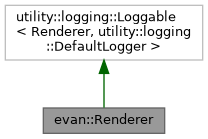
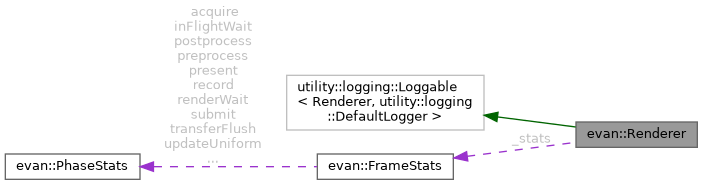
Classes | |
| struct | PipelineVariant |
| Identifies one graphics pipeline variant. More... | |
Public Member Functions | |
| Renderer (std::shared_ptr< DeviceContext > deviceContext, VkRenderPass renderPass, VkSampleCountFlagBits msaaSamples, std::size_t perFrameSlotCount, std::shared_ptr< RessourceManager > ressourceManager) | |
| Constructs a Renderer object. | |
| void | destroy (VkDevice device) |
| Destroys the Renderer and releases associated resources. | |
| size_t | addObject (std::shared_ptr< RenderObject > object) |
| Registers a render object in the renderer's object registry. | |
| bool | updateObject (std::shared_ptr< RenderObject > object, size_t objectID) |
| Updates a render object in the renderer's object registry. | |
| bool | removeObject (size_t objectID) |
| Removes a render object from the renderer's registry. | |
| std::shared_ptr< RenderObject > | getObject (size_t objectID) const |
| Retrieves a render object from the renderer's registry. | |
| Error | drawFrame (const DeviceContext &deviceContext, ASwapchainContext &swapchainContext) |
| Draws a frame by recording command buffers and submitting them to the graphics queue. | |
| void | setScissor (const utility::graphic::ScissorRect &rect) |
| Set the scissor (clip) rectangle applied when recording. | |
| void | clearScissor (void) |
| Clear the active scissor rectangle (restore the full extent). | |
| const FrameStats & | getStats () const noexcept |
| Retrieves the frame statistics of this renderer. | |
| void | resetStats () noexcept |
| Starts a new statistics window. | |
| VkDescriptorPool | getDescriptorPool () const |
| Retrieves the Vulkan descriptor pool associated with the Renderer. | |
| const std::vector< VkBuffer > | getUniformBuffers () const |
| Retrieves the Vulkan descriptor set layout associated with the Renderer. | |
| VkDescriptorSetLayout | getDescriptorSetLayout () const |
| Retrieves the Vulkan descriptor set layout associated with the Renderer. | |
| void | setCullingEnabled (bool enabled) |
| Enables or disables frustum and distance culling. | |
| bool | isCullingEnabled () const |
| Checks whether culling is currently enabled. | |
| void | setMaxDrawDistance (float maxDistance) |
| Sets the maximum draw distance for distance culling. | |
| float | getMaxDrawDistance () const |
| Retrieves the maximum draw distance. | |
| void | setInstancingEnabled (bool enabled) |
| Enables or disables merging of identical meshes. | |
| bool | isInstancingEnabled () const |
| Checks whether identical meshes are merged into one draw. | |
| void | setIndirectDrawingEnabled (bool enabled) |
| Enables or disables indirect drawing. | |
| bool | isIndirectDrawingEnabled () const |
| Checks whether indirect drawing is enabled. | |
| void | setShaderBlendMode (uint32_t shaderID, BlendMode blendMode) |
| Overrides the blend mode used for a shader. | |
| BlendMode | getShaderBlendMode (uint32_t shaderID) const |
| Retrieves the blend mode used for a shader. | |
| void | setOpaqueSortMode (OpaqueSortMode mode) |
| Sets the ordering strategy used for opaque draws. | |
| OpaqueSortMode | getOpaqueSortMode () const |
| Retrieves the ordering strategy used for opaque draws. | |
Static Public Member Functions | |
| static VkRect2D | clampScissor (const utility::graphic::ScissorRect &rect, VkExtent2D extent) |
| Clamp a scissor rectangle to a render target extent. | |
| static bool | viewOwnsInFlightFence (std::size_t viewIndex, std::size_t viewCount) noexcept |
Whether the view at viewIndex carries the in-flight fence for a submission group of viewCount views. | |
Protected Attributes | |
| std::map< PipelineVariant, VkPipeline > | _pipelines |
| std::map< uint32_t, VkPipelineLayout > | _pipelineLayouts |
| std::vector< std::shared_ptr< Frame > > | _frames |
| A collection of frames used for rendering. | |
| std::shared_ptr< DeviceContext > | _deviceContext |
| The device context used to create this renderer's resources. | |
| uint32_t | _currentFrameIndex |
| The index of the current frame being rendered. | |
| FrameStats | _stats |
| Frame statistics window (CPU phases, counters, GPU passes). | |
| float | _timestampPeriod = 0.0f |
| Nanoseconds per GPU timestamp tick, cached at construction. | |
| uint32_t | _timestampValidBits = 0 |
| Number of valid bits in a GPU timestamp, cached at construction. | |
| VkDescriptorSetLayout | _descriptorSetLayout |
| Vulkan descriptor set layout used for rendering operations. | |
| VkDescriptorPool | _descriptorPool |
| Vulkan descriptor pool used for allocating descriptor sets. | |
| std::map< size_t, std::shared_ptr< RenderObject > > | _objects |
| The registry of render objects owned by the renderer. | |
| size_t | _nextObjectID = 1 |
| A counter to generate unique object IDs for the registered render objects. Incremented each time a new object is added. | |
| std::optional< utility::graphic::ScissorRect > | _scissor |
| The active scissor rectangle, in framebuffer pixels. | |
Detailed Description
The Renderer class is responsible for managing the graphics pipeline, descriptor sets, and rendering frames. It interacts with the device context and swapchain context to draw the scene on the screen.
The Renderer class provides methods to create the graphics pipeline, descriptor set layout, and descriptor pool. It also handles the drawing of frames by recording command buffers and updating uniform buffers with scene data. The class maintains a collection of frames for rendering and manages the current frame index for synchronization.
- Note
- The Renderer class is designed to work with Vulkan and requires a valid DeviceContext and ASwapchainContext to function properly. It encapsulates the rendering logic and resource management for a Vulkan-based rendering system.
Definition at line 61 of file Renderer.hpp.
Constructor & Destructor Documentation
◆ Renderer()
| evan::Renderer::Renderer | ( | std::shared_ptr< DeviceContext > | deviceContext, |
| VkRenderPass | renderPass, | ||
| VkSampleCountFlagBits | msaaSamples, | ||
| std::size_t | perFrameSlotCount, | ||
| std::shared_ptr< RessourceManager > | ressourceManager | ||
| ) |
Constructs a Renderer object.
This constructor initializes the Renderer by creating the graphics pipeline, descriptor set layout, and descriptor pool. It takes a reference to the DeviceContext, the Vulkan render pass, and the MSAA sample count as parameters. The constructor sets up the necessary resources for rendering frames and prepares the Renderer for drawing operations.
- Parameters
-
deviceContext A reference to the DeviceContext, which provides access to the Vulkan device and related resources. renderPass The Vulkan render pass that defines the structure of the rendering operations. msaaSamples The MSAA sample count to be used for multisample anti aliasing operations in the graphics pipeline. perFrameSlotCount Number of view/swapchain slots each frame allocates per-frame resources for, normally frameSlotCount(viewCount, swapchainCount). Clamped to [1, MAX_SWAPCHAINS]. ressourceManager A shared pointer to the RessourceManager, which is responsible for managing materials, textures, and other resources used in rendering. The Renderer interacts with the RessourceManager to access the necessary resources for rendering scenes, such as materials and textures associated with render objects.
- Note
- The constructor may throw exceptions if resource creation fails, such as if the graphics pipeline or descriptor pool cannot be created successfully. Ensure that the provided DeviceContext and render pass are valid and properly initialized before constructing the Renderer.
Member Function Documentation
◆ addObject()
| size_t evan::Renderer::addObject | ( | std::shared_ptr< RenderObject > | object | ) |
Registers a render object in the renderer's object registry.
The renderer owns the registry of render objects drawn each frame. The object is assigned a unique object ID, which can later be used to remove it or to access it (e.g. for in-place mesh updates).
- Parameters
-
object A shared pointer to the RenderObject to register.
- Returns
- The unique object ID assigned to the render object.
◆ clampScissor()
|
static |
Clamp a scissor rectangle to a render target extent.
Exposed so the clamping can be covered by a unit test without a device.
- Parameters
-
rect The requested scissor rectangle, in pixels. extent The render target extent, in pixels.
- Returns
- The clamped Vulkan scissor rectangle.
◆ destroy()
Destroys the Renderer and releases associated resources.
This method is responsible for cleaning up all Vulkan resources associated with the Renderer, including the graphics pipeline, pipeline layout, descriptor set layout, descriptor pool, and any frames that were created. It takes a Vulkan device as a parameter to perform the necessary cleanup operations. Implement this method to ensure that all resources related to the Renderer are properly released when the Renderer is no longer needed.
- Parameters
-
device The Vulkan device used to perform cleanup operations for the Renderer.
- Note
- This method should be called when the Renderer is being destroyed to ensure that all Vulkan resources are properly released and to prevent memory leaks. Make sure to handle any exceptions that may arise during resource cleanup to maintain stability in the application.
◆ drawFrame()
| Error evan::Renderer::drawFrame | ( | const DeviceContext & | deviceContext, |
| ASwapchainContext & | swapchainContext | ||
| ) |
Draws a frame by recording command buffers and submitting them to the graphics queue.
This method handles the rendering of a frame by updating the uniform buffer, recording the command buffer with the appropriate render pass and framebuffer, and submitting the command buffer to the graphics queue for execution. It takes references to the DeviceContext and ASwapchainContext as parameters to access the necessary resources and data for rendering. Implement this method to ensure that frames are rendered correctly based on the registered render objects and the swapchain context.
- Parameters
-
deviceContext A reference to the DeviceContext, which provides access to the Vulkan device and related resources. swapchainContext A reference to the ASwapchainContext, which provides access to the swapchain and render pass for rendering operations.
- Returns
- evan::Error::Ok on success. evan::Error::Suboptimal or evan::Error::SwapchainOutOfDate when the swapchain was recreated and the caller should retry on the next frame. Any other value is fatal (e.g. evan::Error::DeviceLost) and the caller should stop cleanly.
- Note
- This method should be called for each frame that needs to be rendered. Ensure that the DeviceContext and ASwapchainContext are properly initialized and contain valid data before calling this method to avoid rendering issues or exceptions during command buffer recording and submission.
◆ getDescriptorPool()
| VkDescriptorPool evan::Renderer::getDescriptorPool | ( | ) | const |
Retrieves the Vulkan descriptor pool associated with the Renderer.
This method returns the Vulkan descriptor pool that is used by the Renderer to allocate descriptor sets for rendering operations. The descriptor pool is a crucial resource for managing descriptor sets, which are used to bind resources such as uniform buffers and textures to the graphics pipeline. Implement this method to provide access to the descriptor pool for other components of the rendering system that may need to allocate descriptor sets.
- Returns
- The Vulkan descriptor pool associated with the Renderer.
◆ getDescriptorSetLayout()
| VkDescriptorSetLayout evan::Renderer::getDescriptorSetLayout | ( | ) | const |
Retrieves the Vulkan descriptor set layout associated with the Renderer.
This method returns the Vulkan descriptor set layout that defines the structure of the descriptor sets used by the Renderer. The descriptor set layout specifies the types and counts of resources that can be bound to the graphics pipeline, such as uniform buffers and textures. Implement this method to provide access to the descriptor set layout for other components of the rendering system that may need to create or manage descriptor sets based on this layout.
- Returns
- The Vulkan descriptor set layout associated with the Renderer.
◆ getMaxDrawDistance()
|
inline |
Retrieves the maximum draw distance.
- Returns
- The maximum draw distance (0 means disabled).
Definition at line 379 of file Renderer.hpp.
◆ getObject()
| std::shared_ptr< RenderObject > evan::Renderer::getObject | ( | size_t | objectID | ) | const |
Retrieves a render object from the renderer's registry.
- Parameters
-
objectID The object ID of the render object to retrieve.
- Returns
- A shared pointer to the RenderObject if found, or nullptr if no object with the given ID exists.
◆ getOpaqueSortMode()
|
inline |
Retrieves the ordering strategy used for opaque draws.
- Returns
- The current ordering strategy.
Definition at line 513 of file Renderer.hpp.
◆ getShaderBlendMode()
| BlendMode evan::Renderer::getShaderBlendMode | ( | uint32_t | shaderID | ) | const |
Retrieves the blend mode used for a shader.
- Parameters
-
shaderID The shader to look up.
- Returns
- The blend mode resulting from setShaderBlendMode(), or BlendMode::Opaque when no override was registered.
◆ getStats()
|
inlinenoexcept |
Retrieves the frame statistics of this renderer.
Returns the live report window: CPU phase timings, per-view GPU pass times (when timestamp queries are available) and per-frame counters. The data accumulates in memory and is never logged per frame; the renderer itself emits one aggregated log record every EVAN_STATS_INTERVAL frames when EVAN_STATS is set. An application may read this accessor to draw its own debug overlay.
The window is reset after each aggregated log record and by resetStats().
- Returns
- The current frame statistics.
Definition at line 270 of file Renderer.hpp.
◆ getUniformBuffers()
Retrieves the Vulkan descriptor set layout associated with the Renderer.
This method returns the Vulkan descriptor set layout that defines the structure of the descriptor sets used by the Renderer. The descriptor set layout specifies the types and counts of resources that can be bound to the graphics pipeline, such as uniform buffers and textures. Implement this method to provide access to the descriptor set layout for other components of the rendering system that may need to create or manage descriptor sets based on this layout.
- Returns
- The Vulkan descriptor set layout associated with the Renderer.
◆ isCullingEnabled()
|
inline |
Checks whether culling is currently enabled.
- Returns
- True when culling is enabled.
Definition at line 356 of file Renderer.hpp.
◆ isIndirectDrawingEnabled()
|
inline |
Checks whether indirect drawing is enabled.
- Returns
- True when indirect drawing is enabled.
Definition at line 437 of file Renderer.hpp.
◆ isInstancingEnabled()
|
inline |
Checks whether identical meshes are merged into one draw.
- Returns
- True when consecutive identical meshes are merged.
Definition at line 412 of file Renderer.hpp.
◆ removeObject()
Removes a render object from the renderer's registry.
- Parameters
-
objectID The object ID of the render object to remove.
- Returns
- True if the object was found and removed, false otherwise.
◆ resetStats()
|
inlinenoexcept |
Starts a new statistics window.
Clears the accumulated phase samples, counters and frame count; keeps the enabled/available flags.
Definition at line 281 of file Renderer.hpp.

◆ setCullingEnabled()
Enables or disables frustum and distance culling.
When enabled, meshes whose bounds are fully outside the current view frustum (or beyond the maximum draw distance) are skipped before recording their draw commands. Disable for debugging: a wrong bound then never hides geometry.
- Parameters
-
enabled True to cull, false to draw every mesh.
Definition at line 346 of file Renderer.hpp.
◆ setIndirectDrawingEnabled()
Enables or disables indirect drawing.
When enabled, the sorted draws are written into the per-frame indirect buffer and submitted with vkCmdDrawIndexedIndirect, one call per consecutive group sharing the same pipeline/descriptor/ vertex state. Disabled by default.
- Parameters
-
enabled True to batch draws through the indirect buffer.
Definition at line 427 of file Renderer.hpp.
◆ setInstancingEnabled()
Enables or disables merging of identical meshes.
The per-object transform always reaches the GPU: every mesh is drawn with the model matrix of its own slot in the per-view instance buffer, whether or not this flag is set. This flag only controls batching: when enabled, consecutive meshes sharing the same geometry (pipeline, material, vertex and index buffers) are merged into a single vkCmdDrawIndexed with instanceCount > 1.
Merging is only correct with a vertex shader that consumes the per-instance matrix (locations 3 to 6): such a shader places each instance at its own transform, while a shader ignoring the instance data would draw every instance of the run at the same place. Disabled by default.
- Parameters
-
enabled True to merge identical meshes into instanced draws.
Definition at line 402 of file Renderer.hpp.
◆ setMaxDrawDistance()
Sets the maximum draw distance for distance culling.
Meshes whose bounding sphere is entirely beyond this distance from the view are culled. A value of 0 disables distance culling.
- Parameters
-
maxDistance Maximum draw distance in world units (0 disables).
Definition at line 369 of file Renderer.hpp.
◆ setOpaqueSortMode()
|
inline |
Sets the ordering strategy used for opaque draws.
- Parameters
-
mode The ordering strategy to use.
Definition at line 503 of file Renderer.hpp.
◆ setScissor()
Set the scissor (clip) rectangle applied when recording.
The rectangle is expressed in framebuffer pixels and clamped to the swapchain extent when a frame is recorded. It applies to every view recorded in a frame.
- Parameters
-
rect The scissor rectangle to apply.
◆ setShaderBlendMode()
Overrides the blend mode used for a shader.
Materials decide their own blend mode (see utility::graphic::Material::getAlphaMode and GPUMaterial::getBlendMode), which covers assets that declare their transparency. This setter is the escape hatch for shaders whose alpha behaviour is not described by the material, for instance a shader that derives its transparency from something other than the albedo texture.
The override applies to the next recorded frame; the pipelines of both variants already exist.
- Parameters
-
shaderID The shader whose draws are switched. blendMode The blend mode used for every draw of that shader.
◆ updateObject()
| bool evan::Renderer::updateObject | ( | std::shared_ptr< RenderObject > | object, |
| size_t | objectID | ||
| ) |
Updates a render object in the renderer's object registry.
The renderer owns the registry of render objects drawn each frame. The object is updated in-place using the provided object ID, which must correspond to an existing registered render object.
- Parameters
-
object A shared pointer to the RenderObject to update. objectID The unique object ID of the render object to update.
- Returns
- True if the update was successful, false otherwise.
◆ viewOwnsInFlightFence()
|
staticnoexcept |
Whether the view at viewIndex carries the in-flight fence for a submission group of viewCount views.
drawFrame records and submits every view of a frame back-to-back and attaches the in-flight fence only to the last submission. The graphics queue executes submissions in order, so the last submission's completion implies every earlier view has completed; attaching the fence to every view would make the CPU wait for each eye in turn and reintroduce the P0-03 inter-eye stall.
Exposed so the invariant can be covered by a unit test.
- Parameters
-
viewIndex Index of the view within the submission group. viewCount Number of views in the submission group.
- Returns
- True when the view is the last one of the group.
Member Data Documentation
◆ _currentFrameIndex
|
protected |
The index of the current frame being rendered.
This member variable keeps track of the index of the current frame being rendered in the _frames vector. It is used to manage synchronization and to ensure that the correct frame resources are accessed during rendering operations. The Renderer updates this index as it cycles through the frames for rendering.
Definition at line 569 of file Renderer.hpp.
◆ _descriptorPool
|
protected |
Vulkan descriptor pool used for allocating descriptor sets.
This member variable holds the Vulkan descriptor pool that is used by the Renderer to allocate descriptor sets for rendering operations. The descriptor pool is a crucial resource for managing descriptor sets, which are used to bind resources such as uniform buffers and textures to the graphics pipeline. It is essential for ensuring that the Renderer can efficiently manage and allocate descriptor sets as needed during rendering operations.
Definition at line 615 of file Renderer.hpp.
◆ _descriptorSetLayout
|
protected |
Vulkan descriptor set layout used for rendering operations.
This member variable holds the Vulkan descriptor set layout that defines the structure of the descriptor sets used by the Renderer. The descriptor set layout specifies the types and counts of resources that can be bound to the graphics pipeline, such as uniform buffers and textures. It is essential for configuring how resources are accessed by shaders and how they are organized in the graphics pipeline during rendering operations.
Definition at line 602 of file Renderer.hpp.
◆ _deviceContext
|
protected |
The device context used to create this renderer's resources.
Kept alive for the lifetime of the Renderer so that frames created from it can safely destroy their Vulkan resources on destruction.
Definition at line 558 of file Renderer.hpp.
◆ _frames
|
protected |
A collection of frames used for rendering.
This member variable holds a vector of Frame objects that are used by the Renderer to manage the rendering of frames. Each Frame contains the necessary Vulkan resources, such as command buffers and synchronization objects, for rendering operations. The Renderer uses this collection of frames to handle multiple frames in flight and to ensure proper synchronization between rendering operations.
Definition at line 550 of file Renderer.hpp.
◆ _nextObjectID
|
protected |
A counter to generate unique object IDs for the registered render objects. Incremented each time a new object is added.
Definition at line 631 of file Renderer.hpp.
◆ _objects
|
protected |
The registry of render objects owned by the renderer.
The key is the unique object ID returned by addObject(), and the value is the RenderObject whose GPU meshes are drawn each frame. This is the single owner of the renderable content registered by the application.
Definition at line 625 of file Renderer.hpp.
◆ _pipelineLayouts
|
protected |
A map of pipeline layer identifiers to Vulkan pipeline layout objects. This map is used to manage different pipeline layouts for rendering operations based on the pipeline layer associated with render objects. Each entry in the map corresponds to a specific pipeline layer and its associated Vulkan pipeline layout, which defines the interface between shader stages and the resources bound to the graphics pipeline for rendering objects that belong to that layer.
Definition at line 527 of file Renderer.hpp.
◆ _pipelines
|
protected |
Graphics pipeline per (shader, blend mode) variant. Each shader has an opaque and an alpha-blended pipeline so that blending and depth writes are only enabled for the draws that need them.
Definition at line 520 of file Renderer.hpp.
◆ _scissor
|
protected |
The active scissor rectangle, in framebuffer pixels.
When set, it is clamped to the swapchain extent and applied to every view recorded in a frame instead of the full-extent default.
Definition at line 639 of file Renderer.hpp.
◆ _stats
|
protected |
Frame statistics window (CPU phases, counters, GPU passes).
Disabled by default through EVAN_STATS; see FrameStats. The renderer fills the phases while drawing and emits one aggregated record every EVAN_STATS_INTERVAL frames.
Definition at line 578 of file Renderer.hpp.
◆ _timestampPeriod
|
protected |
Nanoseconds per GPU timestamp tick, cached at construction.
Definition at line 583 of file Renderer.hpp.
◆ _timestampValidBits
|
protected |
Number of valid bits in a GPU timestamp, cached at construction.
Definition at line 589 of file Renderer.hpp.
The documentation for this class was generated from the following file:
- headers/evan/Renderer.hpp
