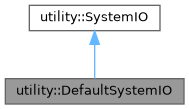
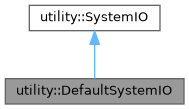
The DefaultSystemIO class is a concrete implementation of the SystemIO interface that loads assets from the file system. More...
#include <headers/utility/system_io/default_system_io.hpp>
Public Member Functions | |
| DefaultSystemIO () | |
| Constructs a DefaultSystemIO. | |
| ~DefaultSystemIO () override | |
| Default destructor for DefaultSystemIO. | |
| bool | loadDirectory (const std::string &directory) override |
| Loads assets from a directory. | |
| std::shared_ptr< utility::File > | add (const std::string &path) override |
| Adds an asset to the manager by loading it from the file system. | |
| void | remove (const std::string &path, bool save=true) override |
| Removes an asset from the manager. | |
| bool | save (const std::string &path, const std::string &newPath="") override |
| Saves an asset to the file system. | |
| virtual std::shared_ptr< utility::File > | add (const std::string &path)=0 |
| Adds an asset to the manager. | |
| std::shared_ptr< utility::File > | add (const std::filesystem::path &path) |
| Adds an asset to the manager. | |
| virtual bool | loadDirectory (const std::string &directory)=0 |
| Loads assets from a directory. | |
| bool | loadDirectory (const std::filesystem::path &directory) |
| Loads assets from a directory. | |
| virtual void | remove (const std::string &path, bool save=true)=0 |
| Removes an asset from the manager. | |
| void | remove (const std::filesystem::path &path, bool save=true) |
| Removes an asset from the manager. | |
| virtual bool | save (const std::string &path, const std::string &newPath="")=0 |
| Saves an asset to the disk. | |
| bool | save (const std::filesystem::path &path, const std::filesystem::path &newPath) |
| Saves an asset to the disk. | |
| bool | save (const std::filesystem::path &path) |
| Saves an asset to its original path. | |
 Public Member Functions inherited from utility::SystemIO Public Member Functions inherited from utility::SystemIO | |
| virtual | ~SystemIO ()=default |
| Default destructor for SystemIO. | |
| bool | loadDirectory (const std::filesystem::path &directory) |
| Loads assets from a directory. | |
| std::shared_ptr< utility::File > | add (const std::filesystem::path &path) |
| Adds an asset to the manager. | |
| void | remove (const std::filesystem::path &path, bool save=true) |
| Removes an asset from the manager. | |
| bool | save (const std::filesystem::path &path, const std::filesystem::path &newPath) |
| Saves an asset to the disk. | |
| bool | save (const std::filesystem::path &path) |
| Saves an asset to its original path. | |
| bool | exists (const std::string &path) const |
| Checks if an asset exists in the manager. | |
| bool | exists (const std::filesystem::path &path) const |
| Checks if an asset exists in the manager. | |
| std::shared_ptr< utility::File > | open (const std::string &path) const |
| Opens an asset from the manager. | |
| std::shared_ptr< utility::File > | open (const std::filesystem::path &path) const |
| Opens an asset from the manager. | |
Protected Member Functions | |
| utility::logging::Logger & | getLogger (void) |
| Get the internal logger. | |
| utility::logging::Logger & | getLogger (void) const |
| Get the internal logger. | |
Additional Inherited Members | |
| Protected Attributes inherited from utility::SystemIO | |
| std::map< std::string, std::shared_ptr< utility::File > > | _assets |
| Map of loaded assets. | |
Detailed Description
The DefaultSystemIO class is a concrete implementation of the SystemIO interface that loads assets from the file system.
Logging is kept private behind an opaque logger to avoid leaking logging headers into the public API.
Definition at line 49 of file default_system_io.hpp.
Constructor & Destructor Documentation
◆ DefaultSystemIO()
| utility::DefaultSystemIO::DefaultSystemIO | ( | ) |
Constructs a DefaultSystemIO.
Definition at line 38 of file default_system_io.cpp.
Member Function Documentation
◆ add() [1/3]
|
inline |
Adds an asset to the manager.
- Parameters
-
path The filesystem path to the asset.
- Returns
- A shared pointer to the File object.
Definition at line 96 of file system_io.hpp.
◆ add() [2/3]
|
overridevirtual |
Adds an asset to the manager by loading it from the file system.
- Parameters
-
path The path to the asset file.
- Returns
- A shared pointer to the loaded File, or nullptr if loading failed.
Implements utility::SystemIO.
Definition at line 89 of file default_system_io.cpp.
◆ add() [3/3]
|
virtual |
Adds an asset to the manager.
- Parameters
-
path The path to the asset.
- Returns
- A shared pointer to the File object.
This method is pure virtual and must be implemented by derived classes. This method is responsible for loading the asset from the specified path by reading the file content and storing it in the _assets map.
Implements utility::SystemIO.
◆ getLogger() [1/2]
|
protected |
Get the internal logger.
- Returns
- Reference to the internal Logger instance.
Definition at line 46 of file default_system_io.cpp.
◆ getLogger() [2/2]
|
protected |
Get the internal logger.
- Returns
- Reference to the internal Logger instance.
Definition at line 51 of file default_system_io.cpp.
◆ loadDirectory() [1/3]
|
inline |
Loads assets from a directory.
- Parameters
-
directory The filesystem path to the directory containing assets.
- Returns
- True if the assets were loaded successfully, false otherwise.
Definition at line 74 of file system_io.hpp.
◆ loadDirectory() [2/3]
|
overridevirtual |
Loads assets from a directory.
- Parameters
-
directory The path to the directory containing the assets.
- Returns
- True if the assets were loaded successfully, false otherwise.
Implements utility::SystemIO.
Definition at line 56 of file default_system_io.cpp.
◆ loadDirectory() [3/3]
|
virtual |
Loads assets from a directory.
- Parameters
-
directory The path to the directory containing the assets.
- Returns
- True if the assets were loaded successfully, false otherwise.
This method is pure virtual and must be implemented by derived classes. It is responsible for loading all assets from the specified directory by reading the file content and storing it in the _assets map.
Implements utility::SystemIO.
◆ remove() [1/3]
|
inline |
Removes an asset from the manager.
- Parameters
-
path The filesystem path to the asset. save Whether to save the asset before removing it.
Definition at line 121 of file system_io.hpp.
◆ remove() [2/3]
|
overridevirtual |
Removes an asset from the manager.
- Parameters
-
path The path to the asset to remove. save Whether to save the asset before removing it.
Implements utility::SystemIO.
Definition at line 131 of file default_system_io.cpp.
◆ remove() [3/3]
|
virtual |
Removes an asset from the manager.
- Parameters
-
path The path to the asset. save Whether to save the asset before removing it (default is true).
This method removes the asset from the _assets map. When removing an asset, the asset file will not be deleted from the disk. When removing an asset, its content is updated on the disk if save is true. If save is false, the asset will be removed from the _assets map without saving its content on the disk. Using a deleted asset will result in undefined behavior.
Implements utility::SystemIO.
◆ save() [1/4]
|
inline |
Saves an asset to its original path.
- Parameters
-
path The filesystem path to the managed asset.
- Returns
- True if the asset was saved successfully, false otherwise.
Definition at line 158 of file system_io.hpp.
◆ save() [2/4]
|
inline |
Saves an asset to the disk.
- Parameters
-
path The filesystem path to the managed asset. newPath The target filesystem path where the asset is written.
- Returns
- True if the asset was saved successfully, false otherwise.
Definition at line 147 of file system_io.hpp.
◆ save() [3/4]
|
overridevirtual |
Saves an asset to the file system.
- Parameters
-
path The path to the asset to save. newPath An optional new path to save the asset to. If not provided, the asset will be saved to its original path.
- Returns
- True if the asset was saved successfully, false otherwise.
Implements utility::SystemIO.
Definition at line 145 of file default_system_io.cpp.
◆ save() [4/4]
|
virtual |
Saves an asset to the disk.
- Parameters
-
path The path to the asset. newPath The new path to save the asset to (optional).
- Returns
- True if the asset was saved successfully, false otherwise.
This method is pure virtual and must be implemented by derived classes. It is responsible for saving the content of the asset to the specified path. If newPath is provided, it will save the asset to that path and will not update the original path. If newPath is not provided, it will save the asset to the original path.
Implements utility::SystemIO.
The documentation for this class was generated from the following files:
- headers/utility/system_io/default_system_io.hpp
- sources/system_io/default_system_io.cpp