Stores every component of a scene, per component type and per entity identifier, and knows which ones changed this frame. More...
#include <headers/guillaume/ecs/component_registry.hpp>
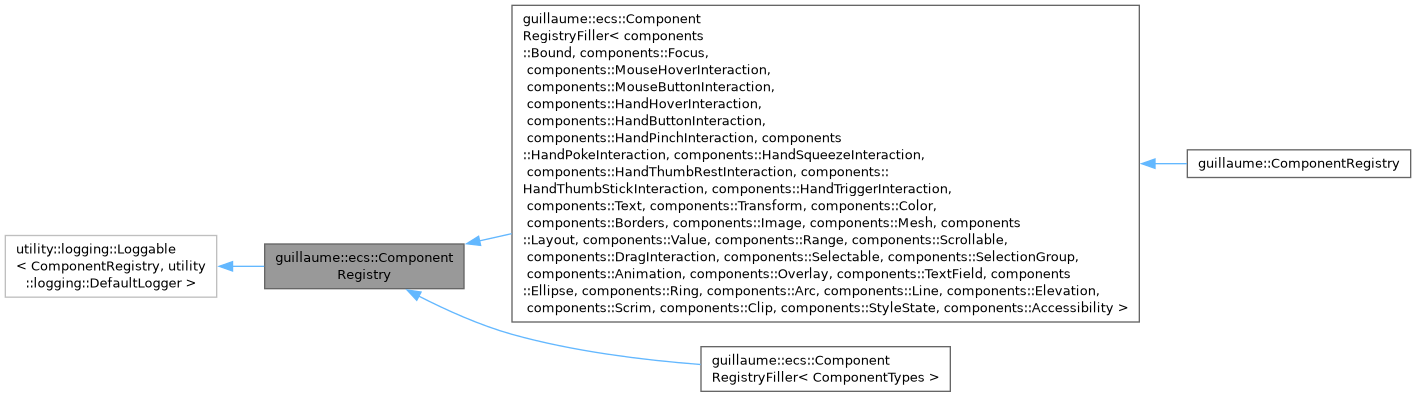
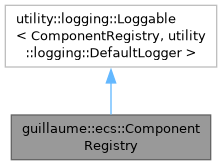
Public Member Functions | |
| ComponentRegistry (void)=default | |
| Create a registry that holds no component. | |
| ~ComponentRegistry (void)=default | |
| Destroy the registry and every component it stores. | |
| template<InheritFromComponent... NeededComponentTypes> | |
| void | registerComponentsForEntity (const Entity::Identifier &entityIdentifier) |
| Give an entity one default-constructed component of each listed type. | |
| template<InheritFromComponent ComponentType, typename... Args> | |
| ComponentType & | addComponent (const Entity::Identifier &entityIdentifier, Args &&...args) |
| Construct a component for an entity, replacing the one it already has, if any. | |
| template<InheritFromComponent ComponentType> | |
| bool | hasComponent (const Entity::Identifier &entityIdentifier) const |
| Tell whether an entity has a component of a given type. | |
| template<InheritFromComponent ComponentType> | |
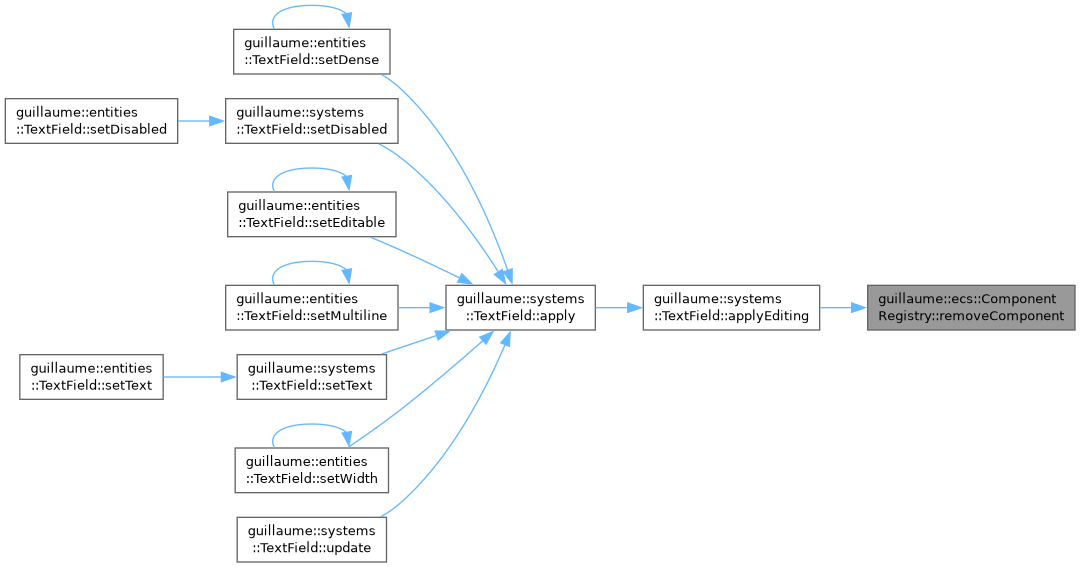
| void | removeComponent (const Entity::Identifier &entityIdentifier) |
| Delete one component of an entity. Does nothing when the entity does not have it. | |
| void | removeEntity (const Entity::Identifier &entityIdentifier) |
| Delete every component of an entity, of every type. | |
| bool | hasChanged (const Entity::Identifier &entityIdentifier) const |
| Tell whether at least one component of an entity was modified since the flags were last reset. | |
| void | resetChangedFlags (void) |
| Mark every component of every entity as unchanged. | |
| template<InheritFromComponent ComponentType> | |
| ComponentType & | getComponent (const Entity::Identifier &entityIdentifier) |
| Get a component of an entity, to read or modify it. | |
| template<InheritFromComponent ComponentType> | |
| const ComponentType & | getComponent (const Entity::Identifier &entityIdentifier) const |
| Get a component of an entity, read-only. | |
Protected Member Functions | |
| template<InheritFromComponent ComponentType> | |
| void | registerNewComponentType (void) |
| Create the (empty) storage of a component type ahead of its first use. | |
Detailed Description
Stores every component of a scene, per component type and per entity identifier, and knows which ones changed this frame.
This is where all the state of the UI lives. Each Scene owns one registry. Widgets write to it when they are built and when their setters are called; systems read and write it every frame through System::getComponent. Everything is addressed by entity identifier, so no entity object is needed to use it.
Storage for a component type is created the first time that type is used: there is no list of component types to maintain.
The changed flags. Every component carries a flag (Component::hasChanged) that its setters raise when a value really changes. hasChanged(identifier) tells whether any component of an entity has its flag raised; resetChangedFlags() lowers all of them and is called by Application::routine once the four phases have run. So a flag raised during a frame, or between two frames by application code, stays visible until the end of the frame in progress. A frame in which no flag is raised means the UI has settled. The flags are information only: System::routine visits every matching entity every frame, whether it changed or not.
Things to watch out for:
- Adding a component here does not update the signature of the entity (Entity::setSignature). A system only visits an entity whose signature contains the system's components.
- addComponent on an entity that already has the component replaces it with a newly constructed one.
- A reference returned by getComponent or addComponent stays valid until that component is removed or replaced.
Definition at line 133 of file component_registry.hpp.
Member Function Documentation
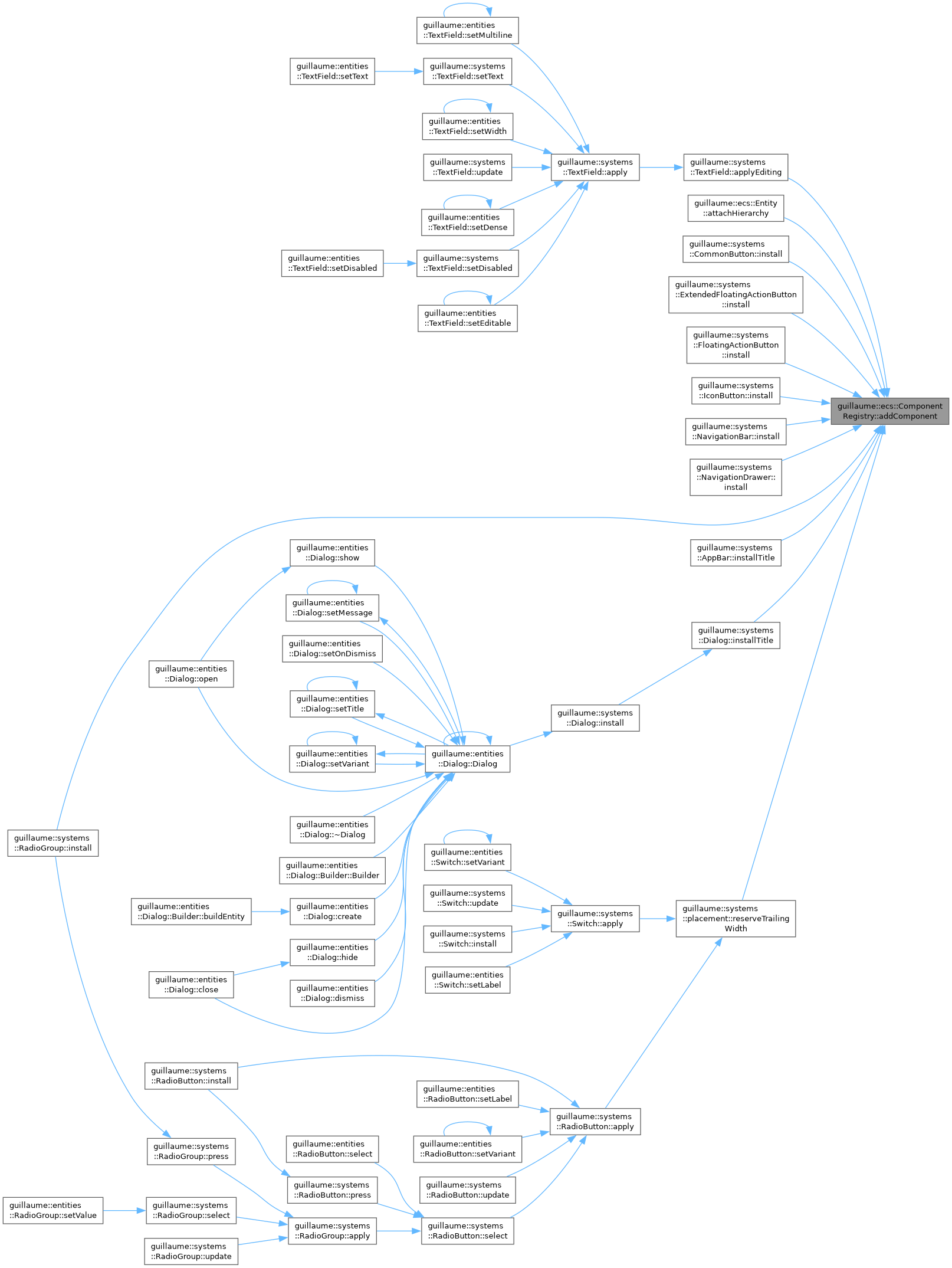
◆ addComponent()
| ComponentType & guillaume::ecs::ComponentRegistry::addComponent | ( | const Entity::Identifier & | entityIdentifier, |
| Args &&... | args ) |
Construct a component for an entity, replacing the one it already has, if any.
The new component is not marked as changed, and the signature of the entity is left as it is.
- Template Parameters
-
ComponentType The component type to add. Args The types of the constructor arguments.
- Parameters
-
entityIdentifier The identifier of the entity that receives the component. args Arguments forwarded to the constructor of ComponentType; none builds a default component.
- Returns
- Reference to the stored component, so setters can be chained on it.
◆ getComponent() [1/2]
| ComponentType & guillaume::ecs::ComponentRegistry::getComponent | ( | const Entity::Identifier & | entityIdentifier | ) |
Get a component of an entity, to read or modify it.
- Template Parameters
-
ComponentType The component type to get.
- Parameters
-
entityIdentifier The identifier of the entity.
- Returns
- Reference to the stored component. It stays valid until the component is removed or replaced.
- Exceptions
-
EntityComponentNotFoundException<ComponentType> When the entity does not have the component.
◆ getComponent() [2/2]
| const ComponentType & guillaume::ecs::ComponentRegistry::getComponent | ( | const Entity::Identifier & | entityIdentifier | ) | const |
Get a component of an entity, read-only.
- Template Parameters
-
ComponentType The component type to get.
- Parameters
-
entityIdentifier The identifier of the entity.
- Returns
- Const reference to the stored component. It stays valid until the component is removed or replaced.
- Exceptions
-
EntityComponentNotFoundException<ComponentType> When the entity does not have the component.
◆ hasChanged()
| bool guillaume::ecs::ComponentRegistry::hasChanged | ( | const Entity::Identifier & | entityIdentifier | ) | const |
Tell whether at least one component of an entity was modified since the flags were last reset.
- Parameters
-
entityIdentifier The identifier of the entity.
- Returns
- True when at least one of its components is marked as changed; false when none is, or when the entity has no component.
- See also
- Component::hasChanged
Definition at line 29 of file component_registry.cpp.
◆ hasComponent()
| bool guillaume::ecs::ComponentRegistry::hasComponent | ( | const Entity::Identifier & | entityIdentifier | ) | const |
Tell whether an entity has a component of a given type.
- Template Parameters
-
ComponentType The component type to look for.
- Parameters
-
entityIdentifier The identifier of the entity.
- Returns
- True when the component exists. False for an unknown identifier, including Entity::InvalidIdentifier.
◆ registerComponentsForEntity()
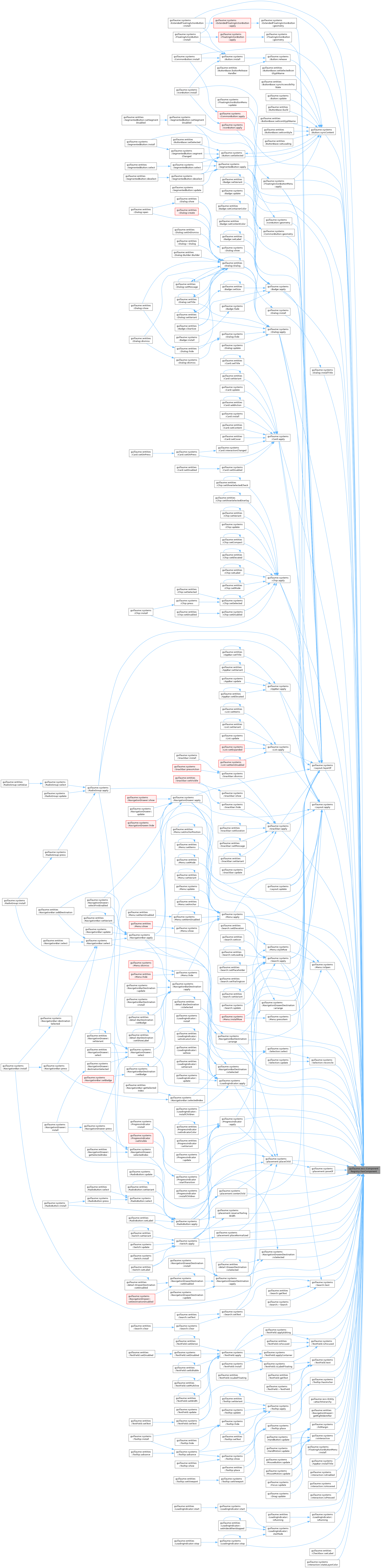
| void guillaume::ecs::ComponentRegistry::registerComponentsForEntity | ( | const Entity::Identifier & | entityIdentifier | ) |
Give an entity one default-constructed component of each listed type.
EntityFiller calls it from its constructor with the component list of the widget. A listed component the entity already has is replaced by a default one.
- Template Parameters
-
NeededComponentTypes The component types to create.
- Parameters
-
entityIdentifier The identifier of the entity that receives the components.
◆ registerNewComponentType()
|
protected |
Create the (empty) storage of a component type ahead of its first use.
Optional: storages are created on demand anyway. ComponentRegistryFiller uses it to prepare a fixed list of types.
- Template Parameters
-
ComponentType The component type to prepare storage for.
◆ removeComponent()
| void guillaume::ecs::ComponentRegistry::removeComponent | ( | const Entity::Identifier & | entityIdentifier | ) |
Delete one component of an entity. Does nothing when the entity does not have it.
- Template Parameters
-
ComponentType The component type to remove.
- Parameters
-
entityIdentifier The identifier of the entity.
◆ removeEntity()
| void guillaume::ecs::ComponentRegistry::removeEntity | ( | const Entity::Identifier & | entityIdentifier | ) |
Delete every component of an entity, of every type.
Only the components are touched: the entity object and its place in the tree are not. To remove an entity completely, call EntityRegistry::removeEntity, which ends up here.
- Parameters
-
entityIdentifier The identifier of the entity.
Definition at line 48 of file component_registry.cpp.
◆ resetChangedFlags()
| void guillaume::ecs::ComponentRegistry::resetChangedFlags | ( | void | ) |
Mark every component of every entity as unchanged.
Application::routine calls it once per frame, after the Render phase. Code that drives systems by hand (a test, for instance) calls it itself between two frames.
Definition at line 40 of file component_registry.cpp.
The documentation for this class was generated from the following files:
- headers/guillaume/ecs/component_registry.hpp
- sources/ecs/component_registry.cpp
