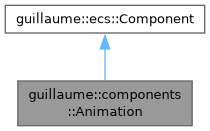
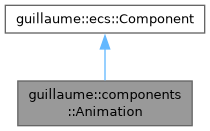
A timer that runs from 0 to a duration and reports its eased progress, from 0 to 1, to a callback on every frame. More...
#include <headers/guillaume/components/animation.hpp>
Public Types | |
| using | SampleHandler |
| Receives the eased progress. | |
| using | CompleteHandler |
| Called on completion. | |
Public Member Functions | |
| Animation (void) | |
| Construct a stopped animation lasting the Material 3 Medium2 motion duration of the theme. | |
| ~Animation (void)=default | |
| Default destructor. | |
| float | getDuration (void) const |
| Get how long one run of the animation lasts. | |
| Animation & | setDuration (float duration) |
| Set how long one run of the animation lasts. | |
| float | getElapsed (void) const |
| Get the time spent in the current run. | |
| Animation & | setElapsed (float elapsed) |
| Move the animation to a point in time, without calling any handler. | |
| float | getProgress (void) const |
| Get how far the current run is, before easing. | |
| bool | isPlaying (void) const |
| Check whether the animation is running. | |
| Animation & | play (void) |
| Start the animation from the beginning, even when it is already running. | |
| Animation & | stop (void) |
| Stop the animation and bring the elapsed time back to 0. | |
| bool | isLooping (void) const |
| Check whether the animation starts again when it completes. | |
| Animation & | setLooping (bool looping) |
| Set whether the animation starts again when it completes. | |
| motion::Easing | getEasing (void) const |
| Get the curve that turns the linear progress into the value passed to the sample handler. | |
| Animation & | setEasing (motion::Easing easing) |
| Set the curve that turns the linear progress into the value passed to the sample handler. | |
| Animation & | setOnSampleHandler (const SampleHandler &handler) |
| Store the callback that applies the animation. | |
| SampleHandler | getOnSampleHandler (void) const |
| Get the callback that applies the animation. | |
| Animation & | setOnCompleteHandler (const CompleteHandler &handler) |
| Store the callback run when the animation reaches its duration. | |
| CompleteHandler | getOnCompleteHandler (void) const |
| Get the callback run when the animation reaches its duration. | |
| void | advance (float deltaTime) |
| Move the animation forward in time and call the handlers. | |
| Public Member Functions inherited from guillaume::ecs::Component | |
| bool | hasChanged (void) const |
| Tell whether a value of the component changed since the flags were last reset (the end of the previous frame). | |
| void | setHasChanged (bool hasChanged) |
| Raise or lower the changed flag. | |
| Component (void)=default | |
| Create a component that is not marked as changed. | |
| virtual | ~Component (void)=default |
| Virtual destructor, so components can be destroyed through the base class. | |
Detailed Description
A timer that runs from 0 to a duration and reports its eased progress, from 0 to 1, to a callback on every frame.
The component does not know what it animates: the sample handler receives the progress and interpolates whatever it wants (a width, a color, a pose). systems::Animation calls advance() on every Animation in the Event phase with the time of the frame, capped at theme::MotionScale::MaxFrameStep.
Nothing runs until play() is called. A playing animation marks the component changed on every frame, so a looping one never lets the frame settle. The handlers run inside the Event phase of the frame.
- See also
- systems::Animation, motion::Easing
Definition at line 60 of file animation.hpp.
Member Typedef Documentation
◆ CompleteHandler
Called on completion.
Definition at line 65 of file animation.hpp.
◆ SampleHandler
Receives the eased progress.
Definition at line 63 of file animation.hpp.
Constructor & Destructor Documentation
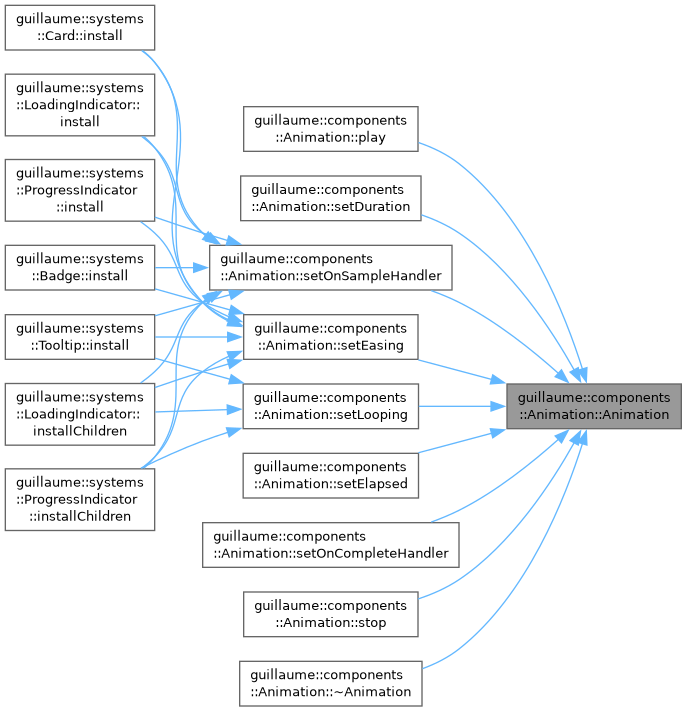
◆ Animation()
| guillaume::components::Animation::Animation | ( | void | ) |
Construct a stopped animation lasting the Material 3 Medium2 motion duration of the theme.
Definition at line 31 of file animation.cpp.

Member Function Documentation
◆ advance()
| void guillaume::components::Animation::advance | ( | float | deltaTime | ) |
Move the animation forward in time and call the handlers.
Called once per frame by systems::Animation. Does nothing when the animation is not playing. Otherwise it adds the delta to the elapsed time, marks the component changed and calls the sample handler with the eased progress. When the duration is reached, the sample handler receives 1, the completion handler runs, then the animation stops, or restarts from 0 when looping.
- Parameters
-
deltaTime The time since the previous frame, in seconds. A negative value counts as 0.
Definition at line 147 of file animation.cpp.

◆ getDuration()
| float guillaume::components::Animation::getDuration | ( | void | ) | const |
Get how long one run of the animation lasts.
- Returns
- The duration, in seconds.
Definition at line 36 of file animation.cpp.
◆ getEasing()
| motion::Easing guillaume::components::Animation::getEasing | ( | void | ) | const |
Get the curve that turns the linear progress into the value passed to the sample handler.
- Returns
- The easing curve; motion::Easing::Standard by default.
Definition at line 110 of file animation.cpp.
◆ getElapsed()
| float guillaume::components::Animation::getElapsed | ( | void | ) | const |
Get the time spent in the current run.
- Returns
- The elapsed time, in seconds; 0 when stopped.
Definition at line 51 of file animation.cpp.
◆ getOnCompleteHandler()
| Animation::CompleteHandler guillaume::components::Animation::getOnCompleteHandler | ( | void | ) | const |
Get the callback run when the animation reaches its duration.
- Returns
- A copy of the handler; empty when none was set.
Definition at line 142 of file animation.cpp.
◆ getOnSampleHandler()
| Animation::SampleHandler guillaume::components::Animation::getOnSampleHandler | ( | void | ) | const |
Get the callback that applies the animation.
- Returns
- A copy of the handler; empty when none was set.
Definition at line 131 of file animation.cpp.
◆ getProgress()
| float guillaume::components::Animation::getProgress | ( | void | ) | const |
Get how far the current run is, before easing.
- Returns
- The elapsed time divided by the duration, clamped to 0 to
- With a duration of 0 or less: 0 while playing, 1 otherwise.
Definition at line 66 of file animation.cpp.

◆ isLooping()
| bool guillaume::components::Animation::isLooping | ( | void | ) | const |
Check whether the animation starts again when it completes.
- Returns
- True when looping.
Definition at line 95 of file animation.cpp.
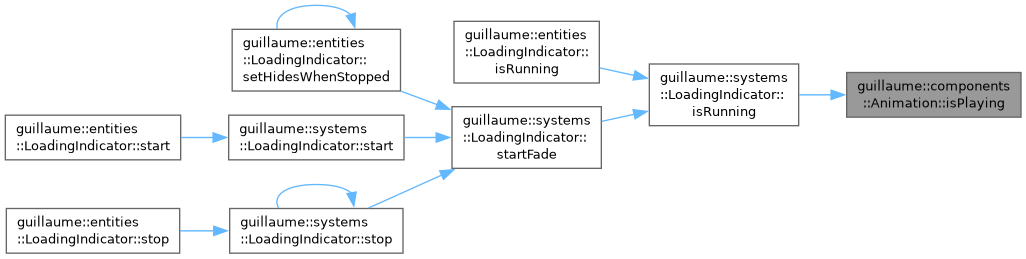
◆ isPlaying()
| bool guillaume::components::Animation::isPlaying | ( | void | ) | const |
Check whether the animation is running.
Definition at line 74 of file animation.cpp.
◆ play()
| Animation & guillaume::components::Animation::play | ( | void | ) |
Start the animation from the beginning, even when it is already running.
Always marks the component changed. The first sample is delivered by the next advance().
- Returns
- This component, to chain calls.
Definition at line 79 of file animation.cpp.

◆ setDuration()
| Animation & guillaume::components::Animation::setDuration | ( | float | duration | ) |
Set how long one run of the animation lasts.
Marks the component changed only when the duration differs.
- Parameters
-
duration The duration, in seconds. With 0 or less the animation completes on its first advance().
- Returns
- This component, to chain calls.
Definition at line 41 of file animation.cpp.

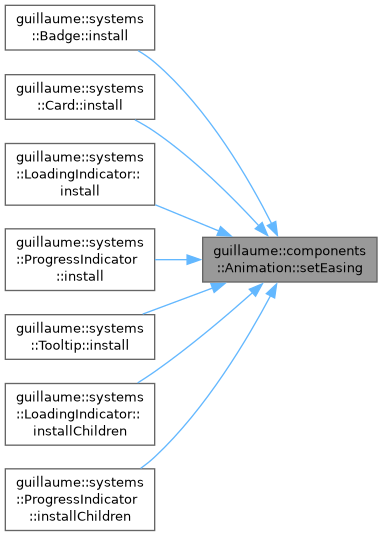
◆ setEasing()
| Animation & guillaume::components::Animation::setEasing | ( | motion::Easing | easing | ) |
Set the curve that turns the linear progress into the value passed to the sample handler.
Marks the component changed only when the curve differs.
- Parameters
-
easing The easing curve.
- Returns
- This component, to chain calls.
Definition at line 115 of file animation.cpp.

◆ setElapsed()
| Animation & guillaume::components::Animation::setElapsed | ( | float | elapsed | ) |
Move the animation to a point in time, without calling any handler.
Marks the component changed only when the time differs.
- Parameters
-
elapsed The time spent in the current run, in seconds.
- Returns
- This component, to chain calls.
Definition at line 56 of file animation.cpp.

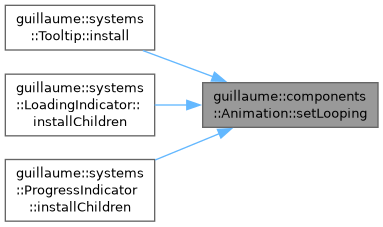
◆ setLooping()
| Animation & guillaume::components::Animation::setLooping | ( | bool | looping | ) |
Set whether the animation starts again when it completes.
Marks the component changed only when the flag differs.
- Parameters
-
looping True to restart from 0 after each completion; the completion handler still runs at the end of every run.
- Returns
- This component, to chain calls.
Definition at line 100 of file animation.cpp.

◆ setOnCompleteHandler()
| Animation & guillaume::components::Animation::setOnCompleteHandler | ( | const CompleteHandler & | handler | ) |
Store the callback run when the animation reaches its duration.
It runs after the last sample, at the end of every run of a looping animation. Does not mark the component changed.
- Parameters
-
handler The callback, or nullptr to remove the current one.
- Returns
- This component, to chain calls.
Definition at line 136 of file animation.cpp.

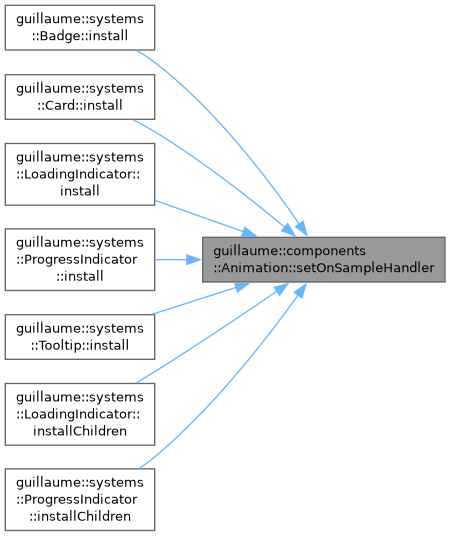
◆ setOnSampleHandler()
| Animation & guillaume::components::Animation::setOnSampleHandler | ( | const SampleHandler & | handler | ) |
Store the callback that applies the animation.
advance() calls it with the eased progress, 0 to 1, while the animation plays, and with exactly 1 on completion. Does not mark the component changed.
- Parameters
-
handler The callback, or nullptr to remove the current one.
- Returns
- This component, to chain calls.
Definition at line 125 of file animation.cpp.

◆ stop()
| Animation & guillaume::components::Animation::stop | ( | void | ) |
Stop the animation and bring the elapsed time back to 0.
Calls neither the sample handler nor the completion handler. Always marks the component changed.
- Returns
- This component, to chain calls.
Definition at line 87 of file animation.cpp.

The documentation for this class was generated from the following files:
- headers/guillaume/components/animation.hpp
- sources/components/animation.cpp
