Marks an entity as something shown temporarily above the rest of the interface (a dialog, a menu, a drawer, a snackbar, a tooltip) and holds how it is dismissed. More...
#include <headers/guillaume/components/overlay.hpp>
Public Types | |
| using | DismissHandler |
| Callback run on dismissal. | |
Public Member Functions | |
| Overlay (void)=default | |
| Create a hidden, modal overlay that is dismissed on Escape and on an outside click, and never by itself. | |
| ~Overlay (void)=default | |
| Default destructor. | |
| bool | isVisible (void) const |
| Tell whether the overlay is shown. | |
| Overlay & | setVisible (bool visible) |
| Show or hide the overlay. | |
| bool | isModal (void) const |
| Tell whether the overlay is modal. | |
| Overlay & | setModal (bool modal) |
| Declare the overlay modal (it must be answered before the rest of the interface is used) or not. | |
| bool | dismissesOnOutsideClick (void) const |
| Tell whether a click outside the overlay dismisses it. | |
| Overlay & | setDismissOnOutsideClick (bool dismiss) |
| Choose whether a click outside the overlay dismisses it. | |
| bool | dismissesOnEscape (void) const |
| Tell whether the Escape key dismisses the overlay. | |
| Overlay & | setDismissOnEscape (bool dismiss) |
| Choose whether the Escape key dismisses the overlay. | |
| float | getAutoDismiss (void) const |
| Get how long the overlay stays shown before it is dismissed by itself. | |
| Overlay & | setAutoDismiss (float delay) |
| Set how long the overlay stays shown before it is dismissed by itself. | |
| bool | hasAutoDismiss (void) const |
| Tell whether the overlay is dismissed by itself after a delay. | |
| float | getElapsed (void) const |
| Get how long the overlay has been counting towards its auto-dismissal. | |
| Overlay & | setElapsed (float elapsed) |
| Store the time counted towards auto-dismissal. | |
| Overlay & | setOnDismissHandler (const DismissHandler &handler) |
| Set the callback run when systems::Overlay dismisses the overlay. | |
| DismissHandler | getOnDismissHandler (void) const |
| Get the callback run when the overlay is dismissed. | |
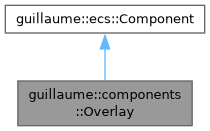
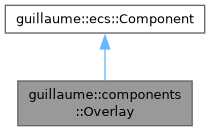
| Public Member Functions inherited from guillaume::ecs::Component | |
| bool | hasChanged (void) const |
| Tell whether a value of the component changed since the flags were last reset (the end of the previous frame). | |
| void | setHasChanged (bool hasChanged) |
| Raise or lower the changed flag. | |
| Component (void)=default | |
| Create a component that is not marked as changed. | |
| virtual | ~Component (void)=default |
| Virtual destructor, so components can be destroyed through the base class. | |
Detailed Description
Marks an entity as something shown temporarily above the rest of the interface (a dialog, a menu, a drawer, a snackbar, a tooltip) and holds how it is dismissed.
The widget systems (systems::Dialog, systems::Menu, ...) write the flags, and their show and hide functions write the visibility. systems::Overlay reads the component in the Event phase: it keeps the visible overlays in a stack and dismisses the top one on Escape or when its auto-dismiss delay has elapsed. A click outside the top overlay dismisses it only when the application reports the click with systems::Overlay::handleOutsideClick; no system calls it.
Dismissing sets the overlay invisible, resets its elapsed time and calls the dismiss handler. Setting a shown overlay invisible by hand has the same effect on the next frame, handler included.
The component holds no drawing state: it is up to the widget system to draw a hidden overlay transparent.
Definition at line 54 of file overlay.hpp.
Member Typedef Documentation
◆ DismissHandler
Callback run on dismissal.
Definition at line 57 of file overlay.hpp.
Member Function Documentation
◆ dismissesOnEscape()
| bool guillaume::components::Overlay::dismissesOnEscape | ( | void | ) | const |
Tell whether the Escape key dismisses the overlay.
- Returns
- True when it does, which is the default.
Definition at line 75 of file overlay.cpp.
◆ dismissesOnOutsideClick()
| bool guillaume::components::Overlay::dismissesOnOutsideClick | ( | void | ) | const |
Tell whether a click outside the overlay dismisses it.
- Returns
- True when it does, which is the default.
Definition at line 60 of file overlay.cpp.
◆ getAutoDismiss()
| float guillaume::components::Overlay::getAutoDismiss | ( | void | ) | const |
Get how long the overlay stays shown before it is dismissed by itself.
- Returns
- The delay, in seconds; 0 means it never is.
Definition at line 90 of file overlay.cpp.
◆ getElapsed()
| float guillaume::components::Overlay::getElapsed | ( | void | ) | const |
Get how long the overlay has been counting towards its auto-dismissal.
- Returns
- The time, in seconds; 0 for an overlay without an auto-dismiss delay.
Definition at line 110 of file overlay.cpp.
◆ getOnDismissHandler()
| Overlay::DismissHandler guillaume::components::Overlay::getOnDismissHandler | ( | void | ) | const |
Get the callback run when the overlay is dismissed.
- Returns
- A copy of the callback; empty when none is set.
Definition at line 127 of file overlay.cpp.
◆ hasAutoDismiss()
| bool guillaume::components::Overlay::hasAutoDismiss | ( | void | ) | const |
Tell whether the overlay is dismissed by itself after a delay.
- Returns
- True when the auto-dismiss delay is greater than 0.
Definition at line 105 of file overlay.cpp.
◆ isModal()
| bool guillaume::components::Overlay::isModal | ( | void | ) | const |
Tell whether the overlay is modal.
- Returns
- True when modal, which is the default.
Definition at line 45 of file overlay.cpp.
◆ isVisible()
| bool guillaume::components::Overlay::isVisible | ( | void | ) | const |
Tell whether the overlay is shown.
- Returns
- True when shown; false by default.
Definition at line 27 of file overlay.cpp.
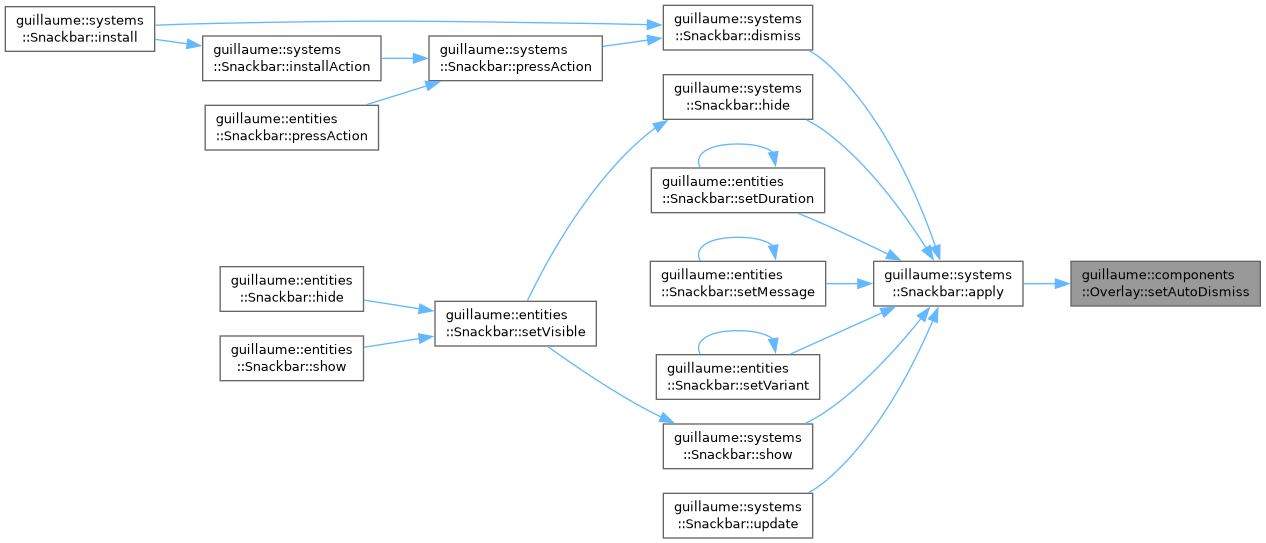
◆ setAutoDismiss()
| Overlay & guillaume::components::Overlay::setAutoDismiss | ( | float | delay | ) |
Set how long the overlay stays shown before it is dismissed by itself.
The countdown only runs while the overlay is the top one. Marks the component changed only when the value differs.
- Parameters
-
delay The delay, in seconds; 0 or less disables auto-dismissal.
- Returns
- This component, for chaining.
Definition at line 95 of file overlay.cpp.

◆ setDismissOnEscape()
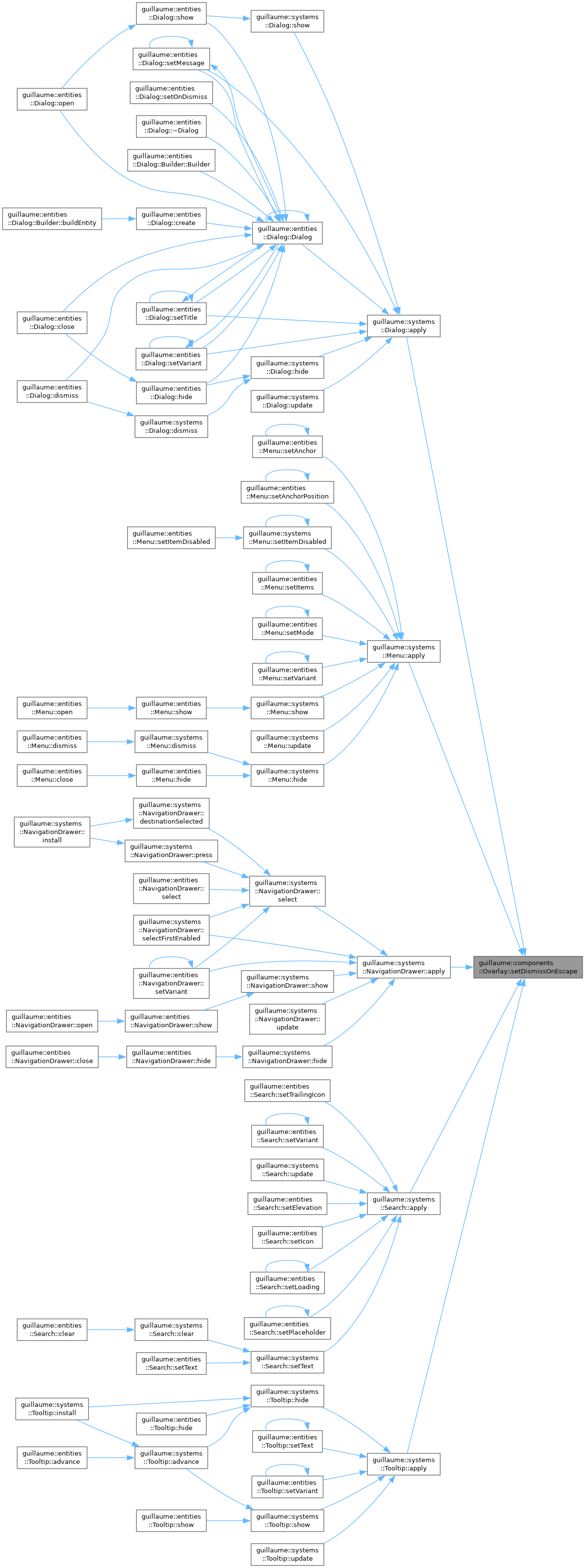
| Overlay & guillaume::components::Overlay::setDismissOnEscape | ( | bool | dismiss | ) |
Choose whether the Escape key dismisses the overlay.
Escape only acts on the top overlay. Marks the component changed only when the flag differs.
- Parameters
-
dismiss True to dismiss on Escape.
- Returns
- This component, for chaining.
Definition at line 80 of file overlay.cpp.

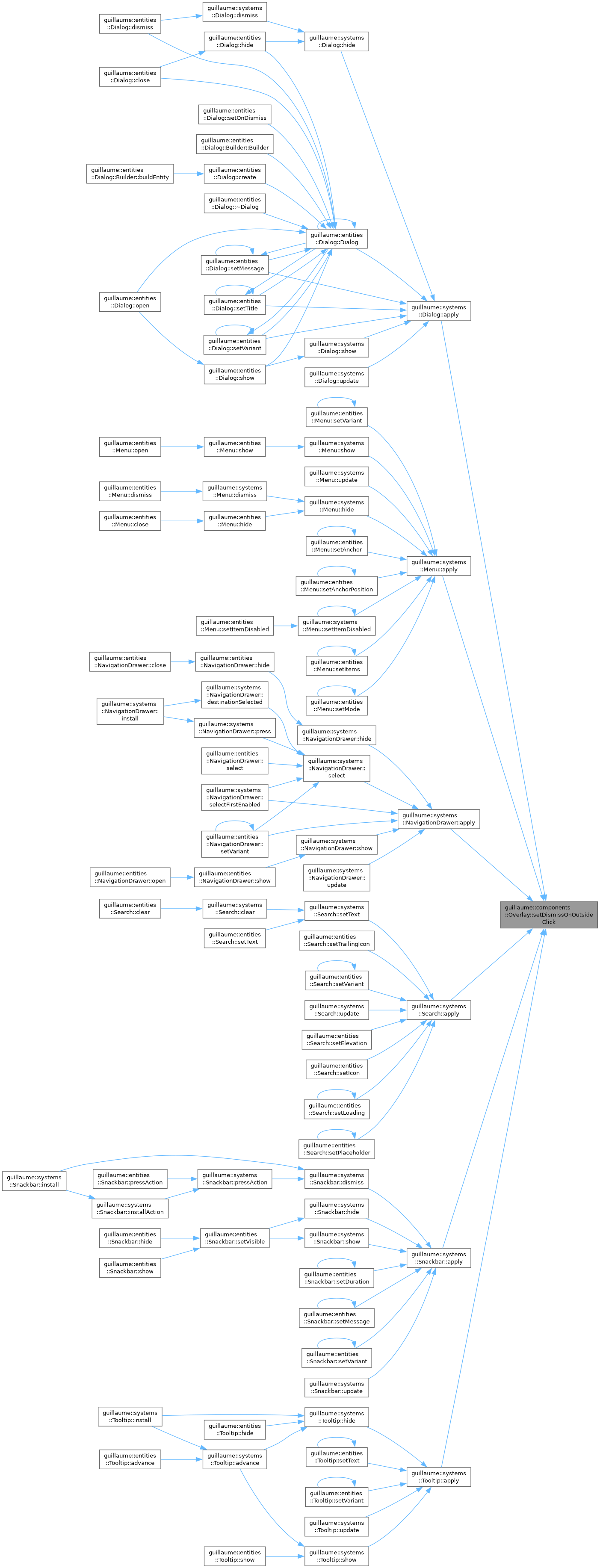
◆ setDismissOnOutsideClick()
| Overlay & guillaume::components::Overlay::setDismissOnOutsideClick | ( | bool | dismiss | ) |
Choose whether a click outside the overlay dismisses it.
Read by systems::Overlay::handleOutsideClick, for the top overlay only. Marks the component changed only when the flag differs.
- Parameters
-
dismiss True to dismiss on an outside click.
- Returns
- This component, for chaining.
Definition at line 65 of file overlay.cpp.

◆ setElapsed()
| Overlay & guillaume::components::Overlay::setElapsed | ( | float | elapsed | ) |
Store the time counted towards auto-dismissal.
systems::Overlay adds the frame time to it; write 0 to restart the countdown. Does not mark the component changed.
- Parameters
-
elapsed The new elapsed time, in seconds.
- Returns
- This component, for chaining.
Definition at line 115 of file overlay.cpp.

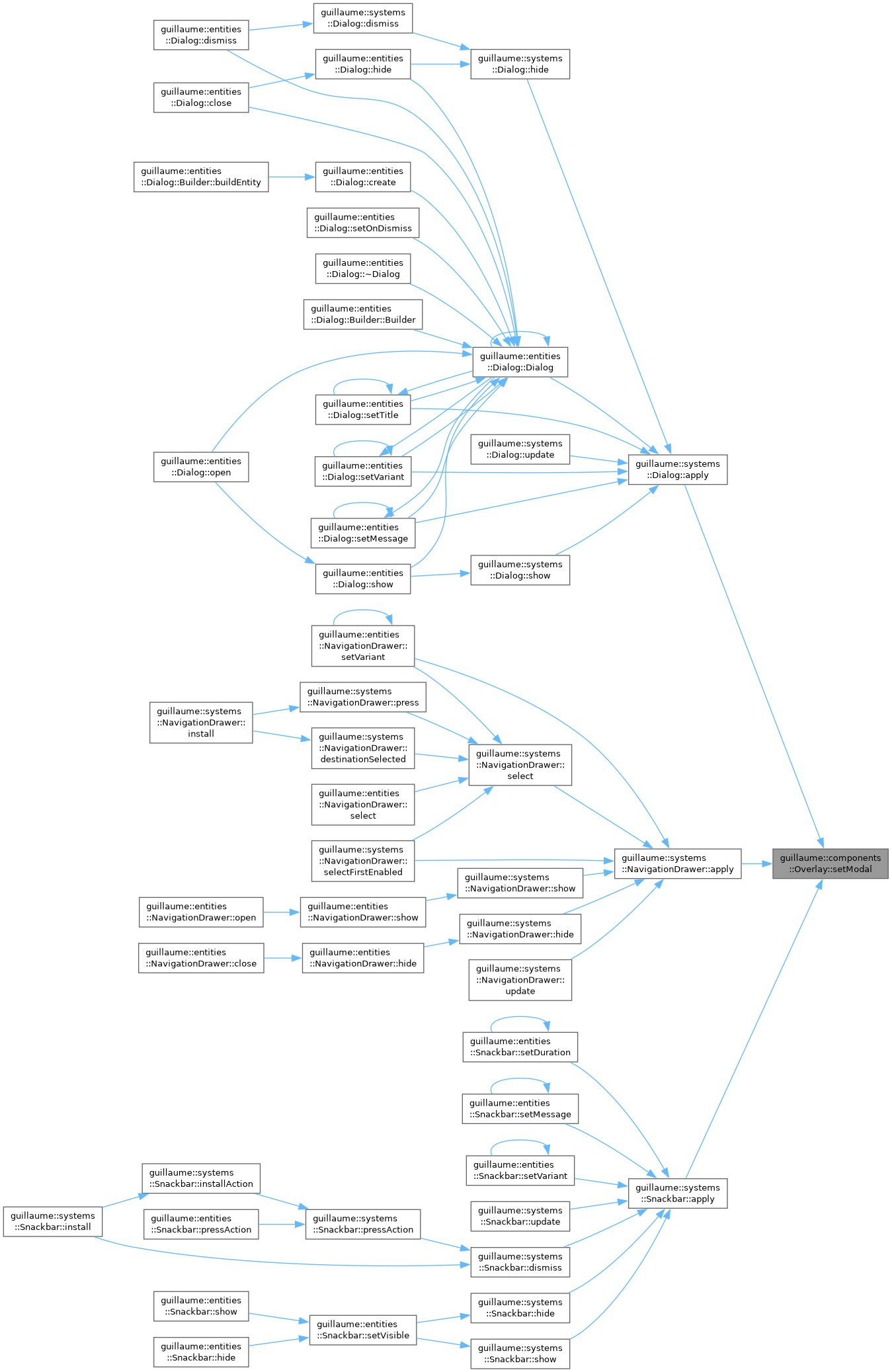
◆ setModal()
| Overlay & guillaume::components::Overlay::setModal | ( | bool | modal | ) |
Declare the overlay modal (it must be answered before the rest of the interface is used) or not.
The flag is a declaration made by the widget system: a dialog is modal, a snackbar or a tooltip is not. Marks the component changed only when the flag differs.
- Parameters
-
modal True for a modal overlay.
- Returns
- This component, for chaining.
Definition at line 50 of file overlay.cpp.

◆ setOnDismissHandler()
| Overlay & guillaume::components::Overlay::setOnDismissHandler | ( | const DismissHandler & | handler | ) |
Set the callback run when systems::Overlay dismisses the overlay.
Widget systems install their own here (for example to hide the widget and call the user's callback), so replacing it on a widget disconnects that. Does not mark the component changed.
- Parameters
-
handler The callback; an empty one removes it.
- Returns
- This component, for chaining.
Definition at line 121 of file overlay.cpp.

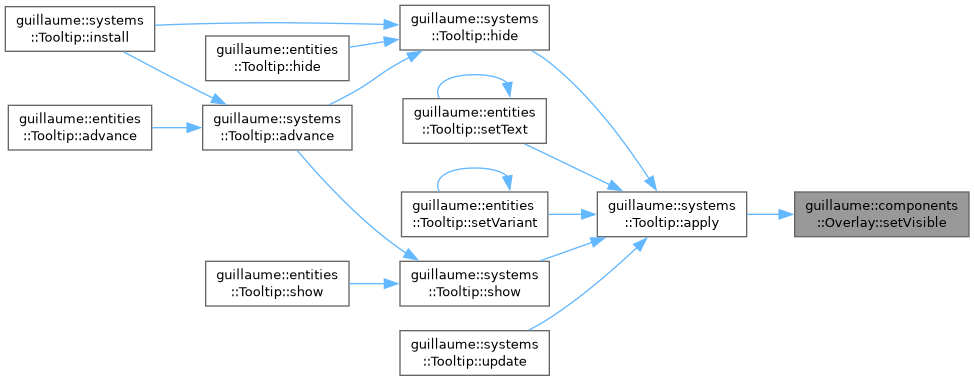
◆ setVisible()
| Overlay & guillaume::components::Overlay::setVisible | ( | bool | visible | ) |
Show or hide the overlay.
Hiding also resets the elapsed time to 0. On its next pass, systems::Overlay puts a newly shown overlay on top of its stack, and dismisses (handler included) one that was hidden this way. Marks the component changed only when the flag differs.
- Parameters
-
visible True to show the overlay.
- Returns
- This component, for chaining.
Definition at line 32 of file overlay.cpp.

The documentation for this class was generated from the following files:
- headers/guillaume/components/overlay.hpp
- sources/components/overlay.cpp
