Keeps the stack of open overlays (dialogs, menus, snackbars) and closes the top one on Escape or when its delay runs out. More...
#include <headers/guillaume/systems/overlay.hpp>


Public Member Functions | |
| Overlay (event::EventBus &eventBus, utility::Engine &engine) | |
| Create the system, in the Event phase, and subscribe it to keyboard events (for Escape). | |
| ~Overlay (void) override=default | |
| Default destructor. | |
| void | prepare (void) override |
| Once per frame: take the next pending keyboard event, count down the top overlay, and handle Escape. | |
| void | update (const ecs::Entity::Identifier &entityIdentifier) override |
| Make the stack agree with the visibility of one overlay. | |
| void | show (const ecs::Entity::Identifier &entityIdentifier) |
| Open an overlay at once: push it on top of the stack, make its component visible and turn viewport input capture off. | |
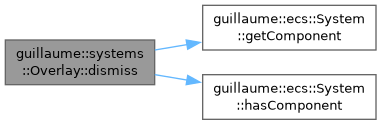
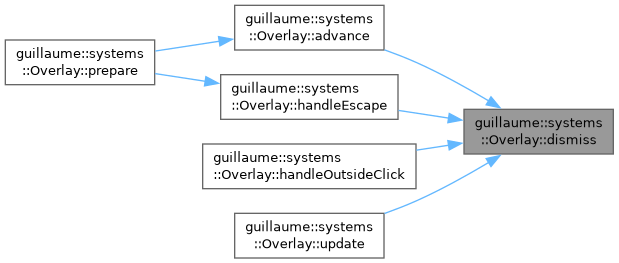
| void | dismiss (void) |
| Close the top overlay. | |
| void | dismiss (const ecs::Entity::Identifier &entityIdentifier) |
| Close one overlay, wherever it is in the stack. | |
| bool | isOpen (const ecs::Entity::Identifier &entityIdentifier) const |
| Whether an overlay is open, that is, in the stack. | |
| ecs::Entity::Identifier | getTop (void) const |
| The overlay opened last, the one Escape and the countdown apply to. | |
| std::size_t | getDepth (void) const |
| The number of open overlays. | |
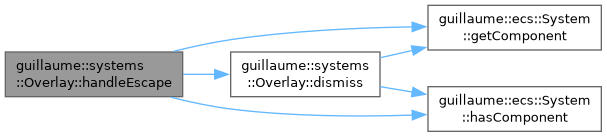
| void | handleEscape (void) |
| Close the top overlay if its component says it dismisses on Escape. Called by prepare() on an Escape key-down. | |
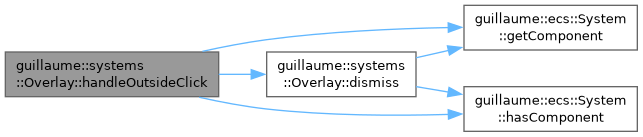
| void | handleOutsideClick (const utility::math::Vector2F &point) |
| Close the top overlay if a click landed outside it and its component says it dismisses on outside clicks. | |
| void | advance (float deltaTime) |
| Count down the top overlay and close it when its time is up. | |
| Public Member Functions inherited from guillaume::ecs::SystemFiller< components::Overlay, components::Transform, components::Bound > | |
| SystemFiller (Phase phase) | |
| Create the system and set its signature from ComponentTypes. | |
| virtual | ~SystemFiller (void)=default |
| Virtual destructor. | |
| Public Member Functions inherited from guillaume::ecs::System | |
| System (Phase phase) | |
| Create a system that runs in a given phase, with an empty signature. | |
| virtual | ~System (void)=default |
| Virtual destructor. | |
| Phase | getPhase (void) const noexcept |
| Get the phase of the frame in which the system runs. | |
| Entity::Signature | getSignature (void) const noexcept |
| Get the component types an entity must declare to be visited by this system. | |
| void | routine (ecs::ComponentRegistry &componentRegistry, ecs::EntityRegistry &entityRegistry, const ecs::EntityTreeTraveler &traveler) |
| Run the system once over a scene: prepare(), update() on each matching entity, cleanup(). | |
| void | bindComponentRegistry (ecs::ComponentRegistry &componentRegistry) |
| Bind a component registry so update() can be called directly, without routine(). | |
| void | unbindComponentRegistry (void) |
| Drop the binding made by bindComponentRegistry(). | |
| virtual void | cleanup (void) |
| Called once per pass, after the last update(). | |
| Public Member Functions inherited from guillaume::event::EventManager< utility::event::KeyboardEvent > | |
| EventManager (EventBus &eventBus) | |
| Subscribe to a bus; events of type EventType published after this call are queued. | |
| virtual | ~EventManager (void)=default |
| Virtual destructor. | |
| bool | hasPendingEvents (void) const |
| Tell whether at least one event is queued, waiting for consumeNextEvent(). | |
Additional Inherited Members | |
| Protected Member Functions inherited from guillaume::ecs::System | |
| template<InheritFromComponent... ComponentTypes> | |
| void | setSignature (void) |
| Replace the signature by the one made of the given component types. | |
| ecs::EntityRegistry & | getEntityRegistry (void) |
| Get the entity registry of the scene being processed. | |
| const ecs::EntityRegistry & | getEntityRegistry (void) const |
| Get the entity registry of the scene being processed, read-only. | |
| ecs::ComponentRegistry & | getComponentRegistry (void) |
| Get the component registry of the scene being processed. | |
| const ecs::ComponentRegistry & | getComponentRegistry (void) const |
| Get the component registry of the scene being processed, read-only. | |
| template<InheritFromComponent ComponentType> | |
| bool | hasComponent (const ecs::Entity::Identifier &entityIdentifier) const |
| Tell whether an entity has a component, in the bound registry. | |
| template<InheritFromComponent ComponentType> | |
| ComponentType & | getComponent (const ecs::Entity::Identifier &entityIdentifier) |
| Get a component of an entity from the bound registry, to read or modify it. | |
| template<InheritFromComponent ComponentType> | |
| const ComponentType & | getComponent (const ecs::Entity::Identifier &entityIdentifier) const |
| Get a component of an entity from the bound registry, read-only. | |
| template<InheritFromComponent ComponentType> | |
| bool | requireComponent (const ecs::Entity::Identifier &entityIdentifier) |
| Tell whether an entity has a component, and log a warning naming the entity and the component when it does not. | |
| Protected Member Functions inherited from guillaume::event::EventManager< utility::event::KeyboardEvent > | |
| void | consumeNextEvent (void) |
| Take the oldest queued event and make it the last event. | |
| std::shared_ptr< EventType > | getLastEvent (void) |
| Get the event taken by the most recent consumeNextEvent() that found one. | |
Detailed Description
Keeps the stack of open overlays (dialogs, menus, snackbars) and closes the top one on Escape or when its delay runs out.
Runs in the Event phase on entities that have a components::Overlay, a Transform and a Bound. An overlay is open while it is in the stack; the last one opened is the top. Each frame the system:
- pushes an overlay whose component became visible, and dismisses one whose component became hidden, so writing components::Overlay::setVisible is enough to open or close one;
- adds the frame time to the elapsed time of the top overlay and dismisses it once its auto-dismiss delay is reached (only the top overlay counts down);
- dismisses the top overlay on an Escape key-down event, if it dismisses on Escape.
Dismissing writes visible = false and elapsed = 0 on the component and calls its dismiss handler; widget systems such as systems::Snackbar rely on that handler to learn about a timeout. While at least one overlay is open, the engine is told not to capture viewport input; capture is given back when the stack empties.
- Note
- Outside clicks are not detected by the system itself: the code that owns the pointer position calls handleOutsideClick().
- The modal flag of components::Overlay is not read here.
- show(), dismiss(), handleEscape(), handleOutsideClick() and advance() read components through the registry bound to the system. Outside the frame loop, call ecs::System::bindComponentRegistry first; without it only the stack changes (the component is not written and the dismiss handler is not called).
- See also
- components::Overlay
- systems::Snackbar
Definition at line 78 of file overlay.hpp.
Constructor & Destructor Documentation
◆ Overlay()
| guillaume::systems::Overlay::Overlay | ( | event::EventBus & | eventBus, |
| utility::Engine & | engine ) |
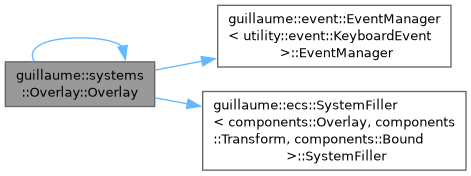
Create the system, in the Event phase, and subscribe it to keyboard events (for Escape).
- Parameters
-
eventBus The event bus delivering the keyboard events. engine The engine told whether the viewport may capture input. It must outlive the system.
Definition at line 29 of file overlay.cpp.
Member Function Documentation
◆ advance()
| void guillaume::systems::Overlay::advance | ( | float | deltaTime | ) |
Count down the top overlay and close it when its time is up.
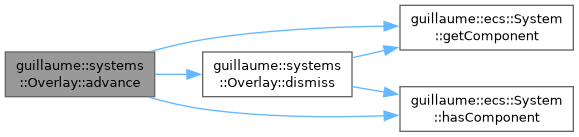
Adds deltaTime to the elapsed time of the top overlay when it has an auto-dismiss delay, and dismisses it once the elapsed time reaches the delay. Called by prepare() each frame.
- Parameters
-
deltaTime The time to add, in seconds.
Definition at line 199 of file overlay.cpp.

◆ dismiss() [1/2]
| void guillaume::systems::Overlay::dismiss | ( | const ecs::Entity::Identifier & | entityIdentifier | ) |
Close one overlay, wherever it is in the stack.
Same effects as dismiss(void), on that overlay. Does nothing when it is not open.
- Parameters
-
entityIdentifier The overlay entity to close.
Definition at line 111 of file overlay.cpp.
◆ dismiss() [2/2]
| void guillaume::systems::Overlay::dismiss | ( | void | ) |
Close the top overlay.
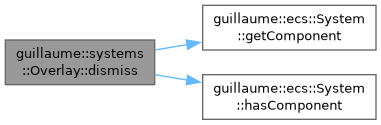
Removes it from the stack, hides its component, resets its elapsed time to 0 and calls its dismiss handler. Viewport input capture is turned back on when the stack becomes empty. Does nothing when no overlay is open.
Definition at line 88 of file overlay.cpp.
◆ getDepth()
| std::size_t guillaume::systems::Overlay::getDepth | ( | void | ) | const |
The number of open overlays.
- Returns
- The size of the stack, 0 when none is open.
Definition at line 145 of file overlay.cpp.
◆ getTop()
| ecs::Entity::Identifier guillaume::systems::Overlay::getTop | ( | void | ) | const |
The overlay opened last, the one Escape and the countdown apply to.
- Returns
- Its identifier, or ecs::Entity::InvalidIdentifier when no overlay is open.
Definition at line 140 of file overlay.cpp.
◆ handleEscape()
| void guillaume::systems::Overlay::handleEscape | ( | void | ) |
Close the top overlay if its component says it dismisses on Escape. Called by prepare() on an Escape key-down.
Definition at line 150 of file overlay.cpp.

◆ handleOutsideClick()
| void guillaume::systems::Overlay::handleOutsideClick | ( | const utility::math::Vector2F & | point | ) |
Close the top overlay if a click landed outside it and its component says it dismisses on outside clicks.
"Inside" is the axis-aligned rectangle starting at the x and y of the overlay's Transform position, with the size of its Bound. The system does not call this itself.
- Parameters
-
point The click position, in the coordinate space of the overlay's Transform position.
Definition at line 163 of file overlay.cpp.
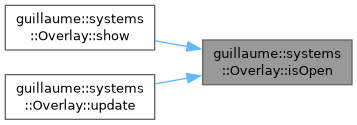
◆ isOpen()
| bool guillaume::systems::Overlay::isOpen | ( | const ecs::Entity::Identifier & | entityIdentifier | ) | const |
Whether an overlay is open, that is, in the stack.
- Parameters
-
entityIdentifier The overlay entity to look for.
- Returns
- True when the overlay is in the stack.
Definition at line 134 of file overlay.cpp.
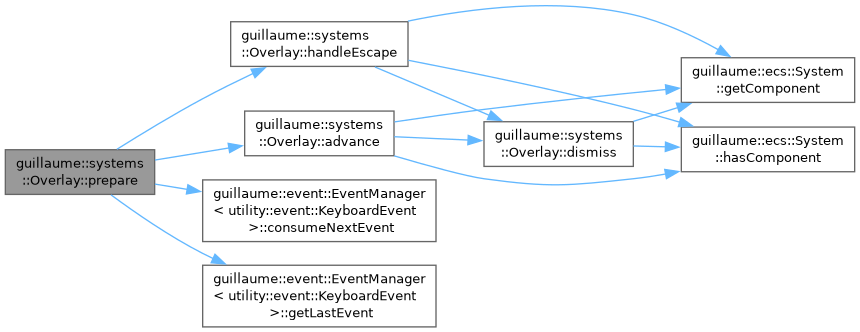
◆ prepare()
|
overridevirtual |
Once per frame: take the next pending keyboard event, count down the top overlay, and handle Escape.
The time passed to advance() is measured on a steady clock since the previous call. Escape is recognized by its scan code, on a key-down event.
Reimplemented from guillaume::ecs::System.
Definition at line 39 of file overlay.cpp.
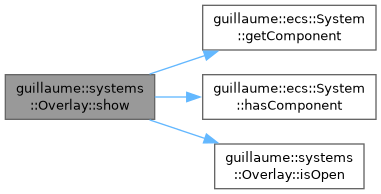
◆ show()
| void guillaume::systems::Overlay::show | ( | const ecs::Entity::Identifier & | entityIdentifier | ) |
Open an overlay at once: push it on top of the stack, make its component visible and turn viewport input capture off.
Does nothing when the overlay is already open.
- Parameters
-
entityIdentifier The overlay entity to open.
Definition at line 72 of file overlay.cpp.
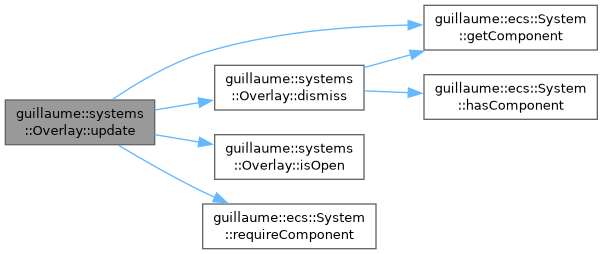
◆ update()
|
overridevirtual |
Make the stack agree with the visibility of one overlay.
A visible overlay that is not open is pushed on top and viewport input capture is turned off; a hidden overlay that is open is dismissed (its dismiss handler is called).
- Parameters
-
entityIdentifier The entity holding the components::Overlay.
Implements guillaume::ecs::System.
Definition at line 56 of file overlay.cpp.
The documentation for this class was generated from the following files:
- headers/guillaume/systems/overlay.hpp
- sources/systems/overlay.cpp
