Arranges the children of a container in a row or a column and sizes the container around them. More...
#include <headers/guillaume/systems/layout.hpp>


Public Member Functions | |
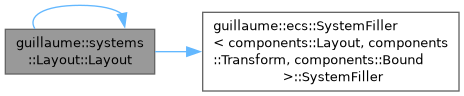
| Layout (void) | |
| Create the system in the Layout phase. | |
| ~Layout (void) override=default | |
| Destroy the system. It owns no resource. | |
| void | update (const ecs::Entity::Identifier &entityIdentifier) override |
| Arrange the children listed in the components::Layout of one container, using the layer of its components::Hierarchy. | |
| Public Member Functions inherited from guillaume::ecs::SystemFiller< components::Layout, components::Transform, components::Bound > | |
| SystemFiller (Phase phase) | |
| Create the system and set its signature from ComponentTypes. | |
| virtual | ~SystemFiller (void)=default |
| Virtual destructor. | |
| Public Member Functions inherited from guillaume::ecs::System | |
| System (Phase phase) | |
| Create a system that runs in a given phase, with an empty signature. | |
| virtual | ~System (void)=default |
| Virtual destructor. | |
| Phase | getPhase (void) const noexcept |
| Get the phase of the frame in which the system runs. | |
| Entity::Signature | getSignature (void) const noexcept |
| Get the component types an entity must declare to be visited by this system. | |
| void | routine (ecs::ComponentRegistry &componentRegistry, ecs::EntityRegistry &entityRegistry, const ecs::EntityTreeTraveler &traveler) |
| Run the system once over a scene: prepare(), update() on each matching entity, cleanup(). | |
| void | bindComponentRegistry (ecs::ComponentRegistry &componentRegistry) |
| Bind a component registry so update() can be called directly, without routine(). | |
| void | unbindComponentRegistry (void) |
| Drop the binding made by bindComponentRegistry(). | |
| virtual void | prepare (void) |
| Called once per pass, before the first update(). | |
| virtual void | cleanup (void) |
| Called once per pass, after the last update(). | |
Static Public Member Functions | |
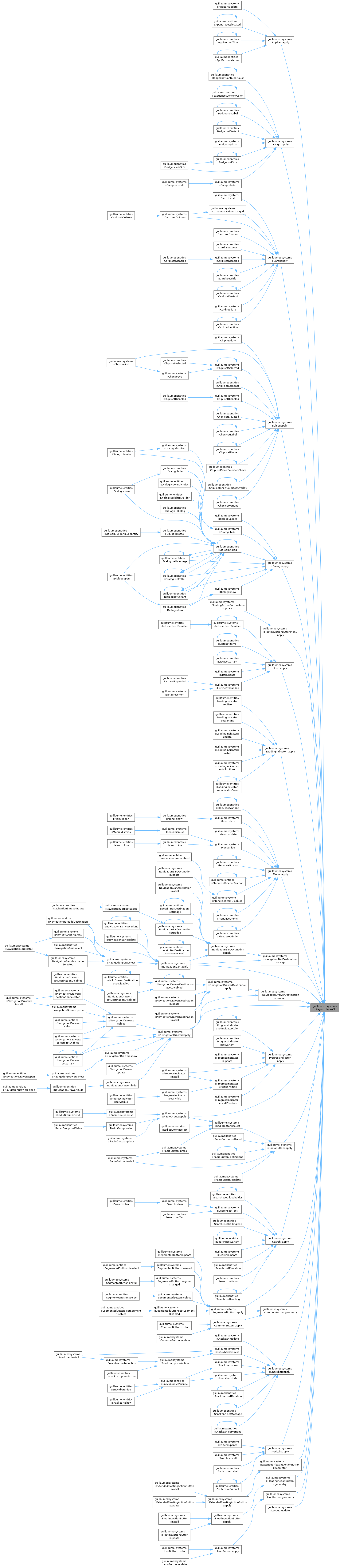
| static void | apply (ecs::ComponentRegistry ®istry, const ecs::Entity::Identifier &parentIdentifier, const std::vector< ecs::Entity::Identifier > &childIdentifiers, std::uint32_t layer=0) |
| Arrange children inside a container and size the container. | |
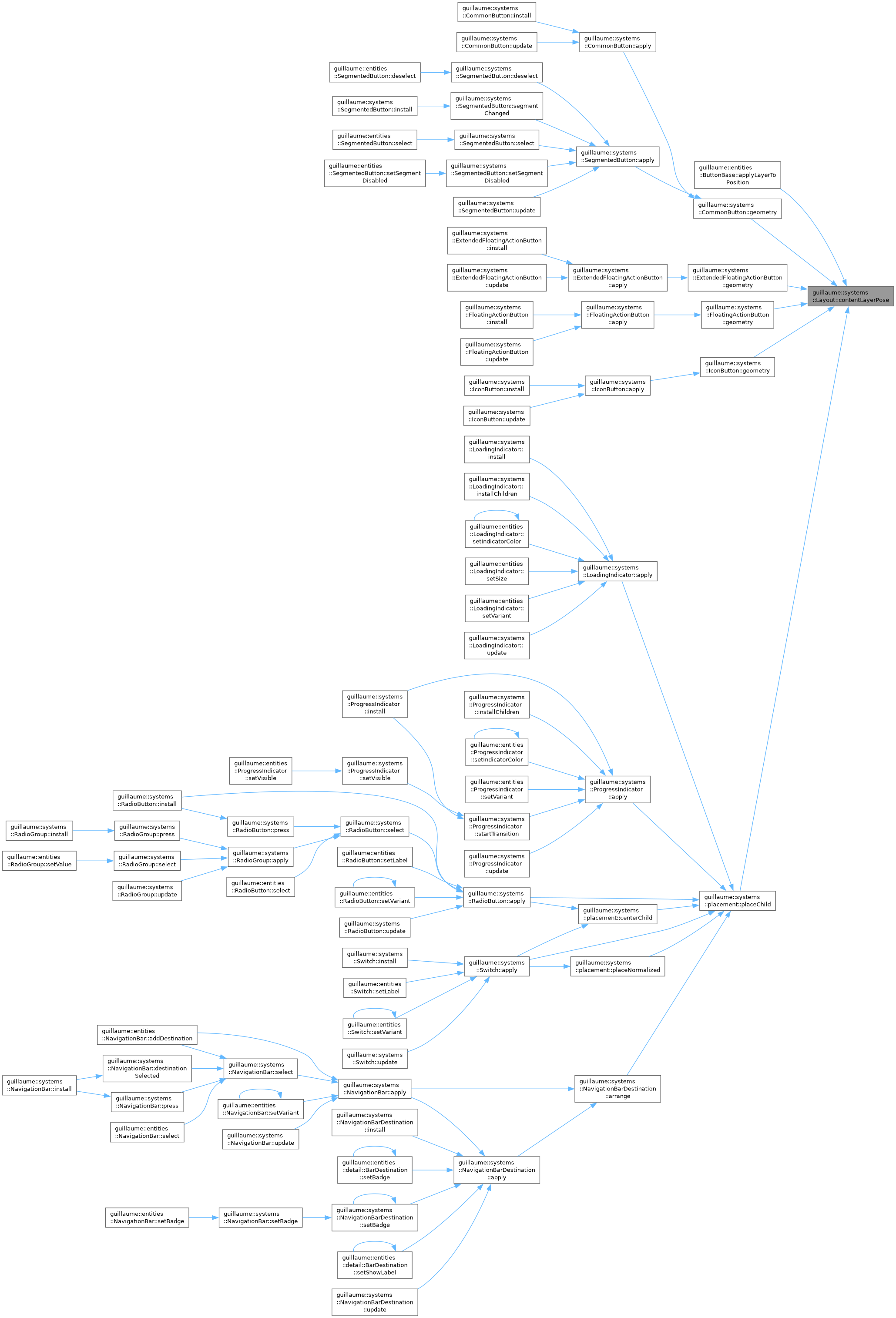
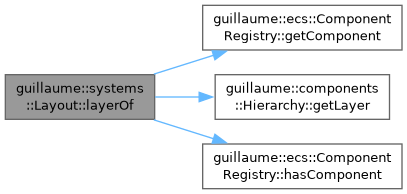
| static std::uint32_t | layerOf (const ecs::ComponentRegistry ®istry, const ecs::Entity::Identifier &identifier) |
| Get the layer of an entity: its depth in the entity tree. | |
| static const utility::graphic::PoseF | applyLayerToPosition (const utility::graphic::PositionF &position, const utility::graphic::OrientationF &orientation, const std::uint32_t &layer) |
| Move a position in front of a container. | |
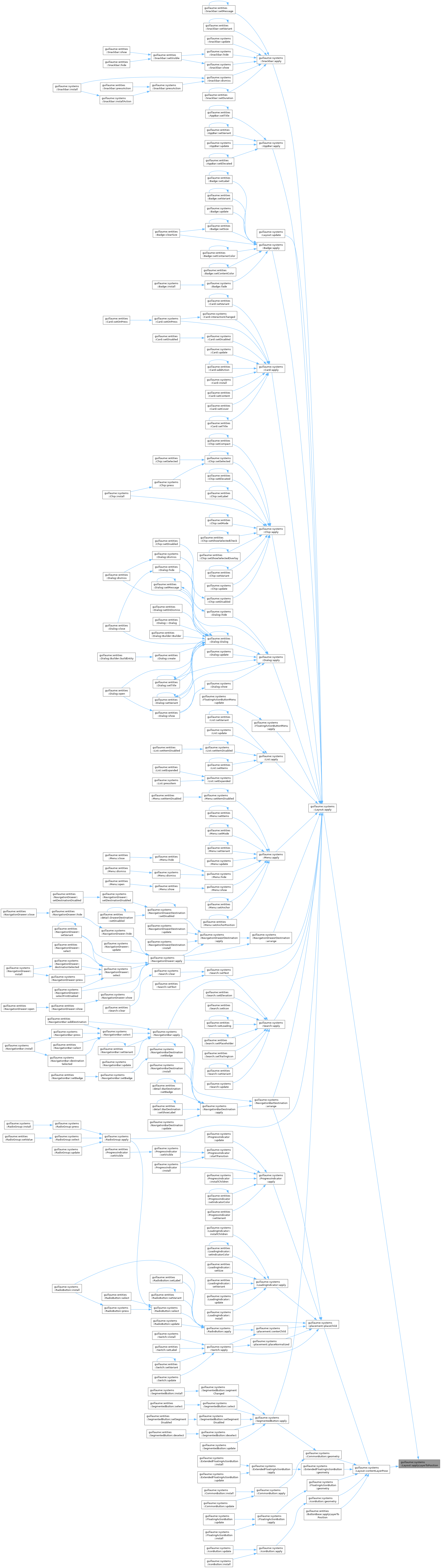
| static const utility::graphic::PoseF | contentLayerPose (const utility::graphic::PositionF &position, const utility::graphic::OrientationF &orientation, const std::uint32_t &containerLayer) |
| Compute the pose of content placed by hand on a container. | |
Static Public Attributes | |
| static constexpr float | LayerDepthStep = 1.0f |
| Depth of one layer: the distance a child is moved towards the viewer, against the forward axis of its container, for each layer. | |
| static constexpr std::uint32_t | ContentLayerOffset = 1 |
| Number of layers added between a container and what is placed on it. | |
Additional Inherited Members | |
| Protected Member Functions inherited from guillaume::ecs::System | |
| template<InheritFromComponent... ComponentTypes> | |
| void | setSignature (void) |
| Replace the signature by the one made of the given component types. | |
| ecs::EntityRegistry & | getEntityRegistry (void) |
| Get the entity registry of the scene being processed. | |
| const ecs::EntityRegistry & | getEntityRegistry (void) const |
| Get the entity registry of the scene being processed, read-only. | |
| ecs::ComponentRegistry & | getComponentRegistry (void) |
| Get the component registry of the scene being processed. | |
| const ecs::ComponentRegistry & | getComponentRegistry (void) const |
| Get the component registry of the scene being processed, read-only. | |
| template<InheritFromComponent ComponentType> | |
| bool | hasComponent (const ecs::Entity::Identifier &entityIdentifier) const |
| Tell whether an entity has a component, in the bound registry. | |
| template<InheritFromComponent ComponentType> | |
| ComponentType & | getComponent (const ecs::Entity::Identifier &entityIdentifier) |
| Get a component of an entity from the bound registry, to read or modify it. | |
| template<InheritFromComponent ComponentType> | |
| const ComponentType & | getComponent (const ecs::Entity::Identifier &entityIdentifier) const |
| Get a component of an entity from the bound registry, read-only. | |
| template<InheritFromComponent ComponentType> | |
| bool | requireComponent (const ecs::Entity::Identifier &entityIdentifier) |
| Tell whether an entity has a component, and log a warning naming the entity and the component when it does not. | |
Detailed Description
Arranges the children of a container in a row or a column and sizes the container around them.
Runs in the Layout phase on every entity that has Layout, Transform and Bound.
- Reads: the container's components::Layout (axis, alignments, spacing, padding, fixed size and the list of children to arrange), its components::Transform, and the components::Bound of each child.
- Writes: the position of each child's components::Transform, and the container's components::Bound (the fixed size when one is set, otherwise the size of the content plus the padding).
The children arranged are the ones listed in components::Layout::getChildren, in that order. A child of the entity tree that is not in the list (a switch thumb, a label placed by its widget system) keeps the pose its owner gave it.
The rules live in the static apply(), so a widget system can arrange a container at once instead of waiting for the frame:
Things to know:
- Children are never resized. Their Bound comes from the Measure phase (text, icons) or from their own layout.
- The Layout phase visits parents before children. A container therefore reads the Bound a nested container computed on the previous frame, and a change of size deep in the tree reaches the root one level per frame.
- The container's Bound is overwritten every frame: set a fixed width or height on components::Layout to impose a size.
- Children are offset along the world X and Y axes from the container's position; only the depth lift follows the container's orientation.
- The widget systems are registered after this one because they place their own children from the bounds resolved here.
Definition at line 81 of file layout.hpp.
Constructor & Destructor Documentation
◆ Layout()
| guillaume::systems::Layout::Layout | ( | void | ) |
Create the system in the Layout phase.
Definition at line 69 of file layout.cpp.
Member Function Documentation
◆ apply()
|
static |
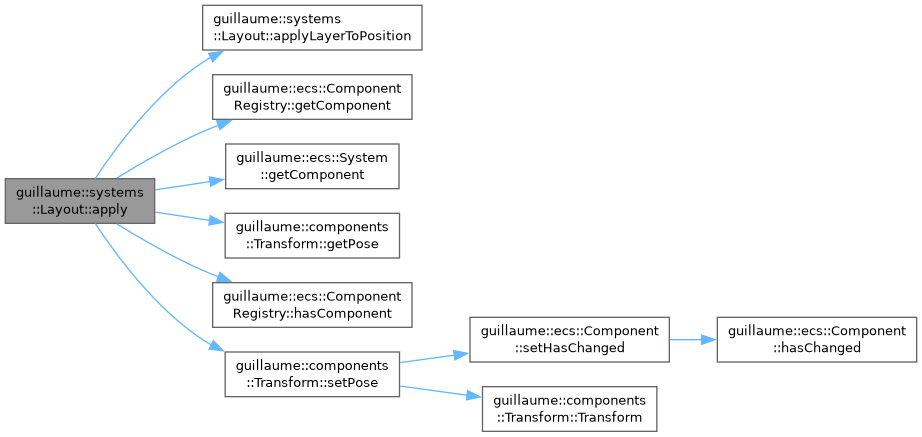
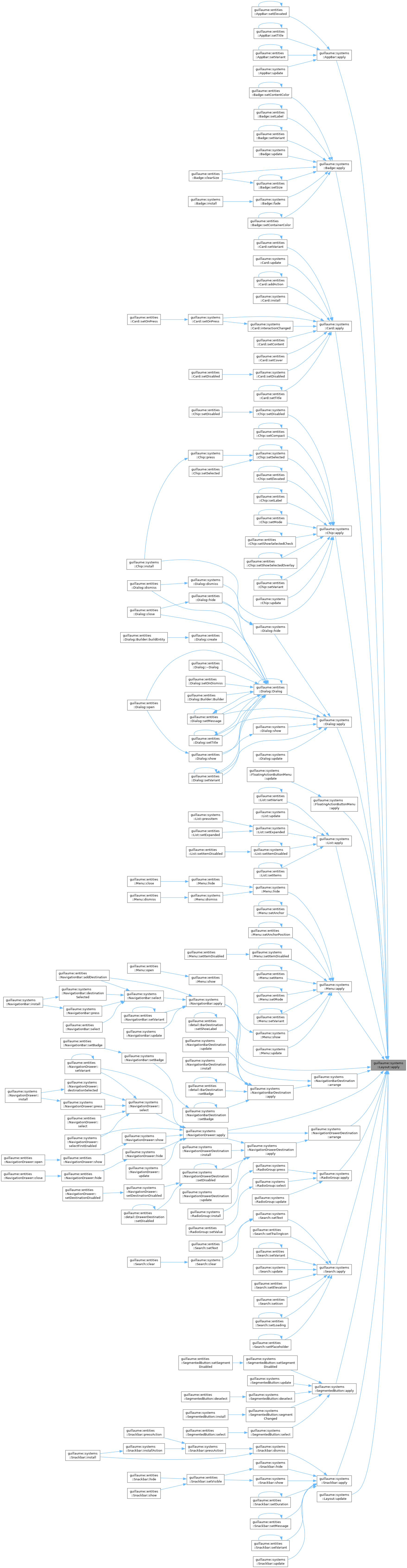
Arrange children inside a container and size the container.
Children are placed one after the other along the axis of the container's components::Layout, separated by its spacing and inset by its padding, then aligned along both axes. Each child is lifted layer + ContentLayerOffset layers in front of the container. The container's components::Bound receives the fixed size when one is set, otherwise the content size plus twice the padding.
- Parameters
-
registry The registry holding the components. parentIdentifier The container. It must have Layout, Transform and Bound. childIdentifiers The children to arrange, in order. ecs::Entity::InvalidIdentifier and children without Transform or Bound are skipped and take no room. layer The layer of the container, as returned by layerOf().
- Exceptions
-
ecs::EntityComponentNotFoundException When the container lacks one of the three components.
Definition at line 126 of file layout.cpp.
◆ applyLayerToPosition()
|
static |
Move a position in front of a container.
The position is moved by (layer + ContentLayerOffset) *
LayerDepthStep towards the viewer, against the forward axis of orientation.
- Parameters
-
position The position to lift, usually computed in the plane of the container. orientation The orientation of the container. It is copied into the returned pose. layer The layer of the container, as returned by layerOf().
- Returns
- The lifted position with
orientation.
Definition at line 103 of file layout.cpp.
◆ contentLayerPose()
|
static |
Compute the pose of content placed by hand on a container.
Same result as applyLayerToPosition(). Widget systems that place a text or an icon themselves call it so that everything drawn on a container sits at the same distance in front of it.
- Parameters
-
position The position of the content in the plane of the container. orientation The orientation of the container. containerLayer The layer of the container, as returned by layerOf().
- Returns
- The pose to give to the content.
Definition at line 118 of file layout.cpp.

◆ layerOf()
|
static |
Get the layer of an entity: its depth in the entity tree.
- Parameters
-
registry The registry holding the components. identifier The entity to look up.
- Returns
- The layer stored in its components::Hierarchy, or 0 when the entity has no Hierarchy.
Definition at line 90 of file layout.cpp.
◆ update()
|
overridevirtual |
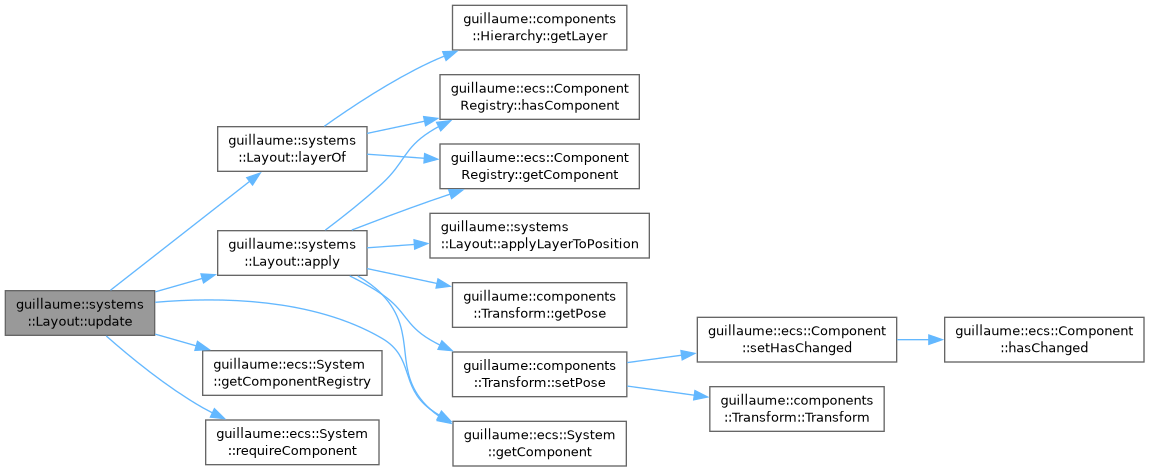
Arrange the children listed in the components::Layout of one container, using the layer of its components::Hierarchy.
- Parameters
-
entityIdentifier The container entity.
Implements guillaume::ecs::System.
Definition at line 75 of file layout.cpp.
Member Data Documentation
◆ ContentLayerOffset
|
staticconstexpr |
Number of layers added between a container and what is placed on it.
Text, icons and other children sit in front of the surface of their container; without this gap both would be at the same depth and flicker (z-fighting).
Definition at line 101 of file layout.hpp.
◆ LayerDepthStep
|
staticconstexpr |
Depth of one layer: the distance a child is moved towards the viewer, against the forward axis of its container, for each layer.
Definition at line 91 of file layout.hpp.
The documentation for this class was generated from the following files:
- headers/guillaume/systems/layout.hpp
- sources/systems/layout.cpp
