The rules of a radio group: a list of radio buttons of which at most one is selected. More...
#include <headers/guillaume/systems/radio_group.hpp>
Public Member Functions | |
| RadioGroup (void) | |
| Create the system for the Layout phase, matching entities that have a components::RadioGroup. | |
| ~RadioGroup (void) override=default | |
| Default destructor. | |
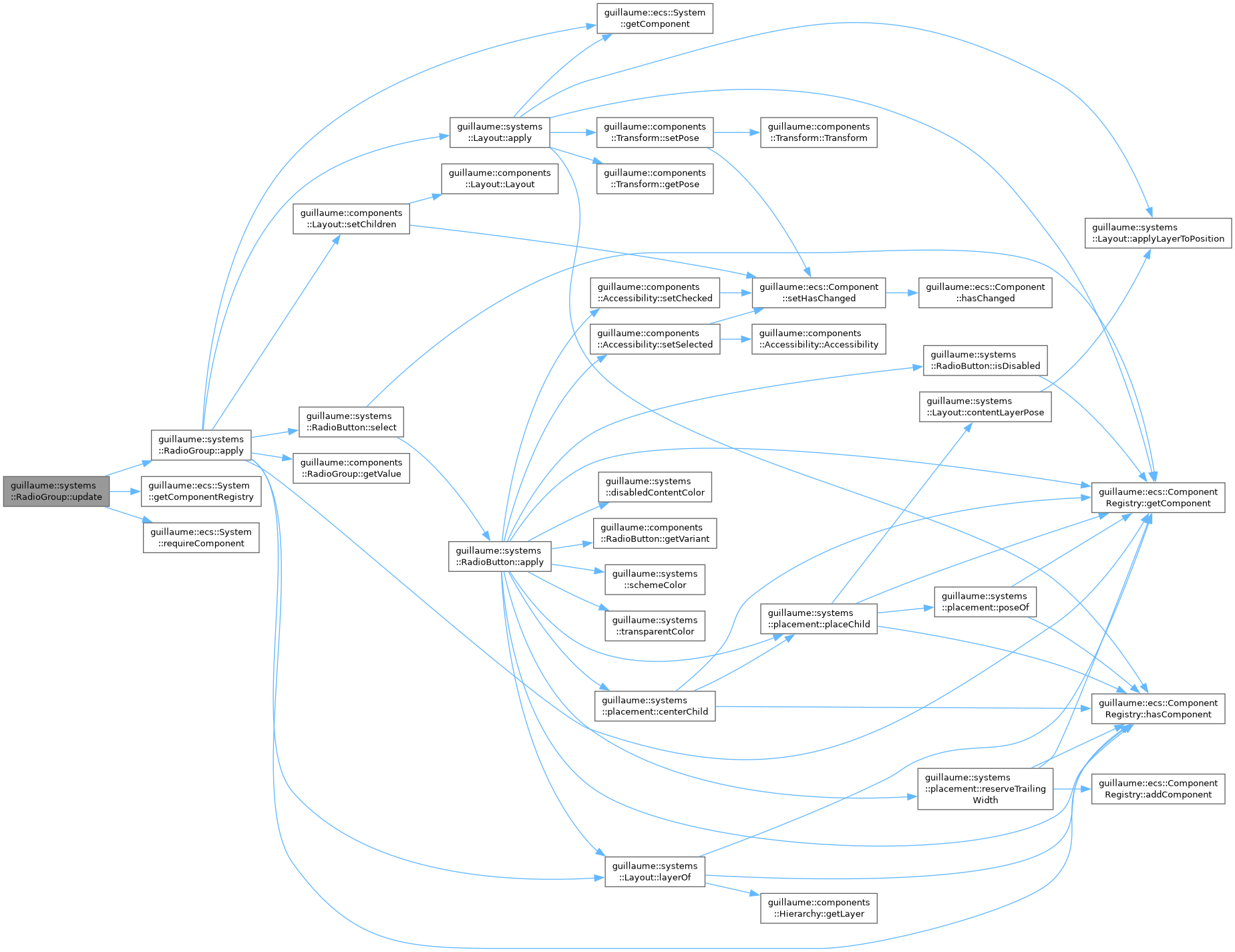
| void | update (const ecs::Entity::Identifier &entityIdentifier) override |
| Frame entry point: call apply on one radio group. | |
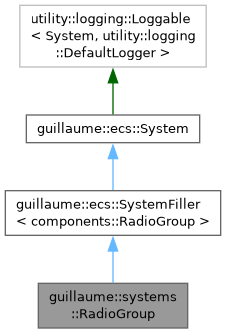
| Public Member Functions inherited from guillaume::ecs::SystemFiller< components::RadioGroup > | |
| SystemFiller (Phase phase) | |
| Create the system and set its signature from ComponentTypes. | |
| virtual | ~SystemFiller (void)=default |
| Virtual destructor. | |
| Public Member Functions inherited from guillaume::ecs::System | |
| System (Phase phase) | |
| Create a system that runs in a given phase, with an empty signature. | |
| virtual | ~System (void)=default |
| Virtual destructor. | |
| Phase | getPhase (void) const noexcept |
| Get the phase of the frame in which the system runs. | |
| Entity::Signature | getSignature (void) const noexcept |
| Get the component types an entity must declare to be visited by this system. | |
| void | routine (ecs::ComponentRegistry &componentRegistry, ecs::EntityRegistry &entityRegistry, const ecs::EntityTreeTraveler &traveler) |
| Run the system once over a scene: prepare(), update() on each matching entity, cleanup(). | |
| void | bindComponentRegistry (ecs::ComponentRegistry &componentRegistry) |
| Bind a component registry so update() can be called directly, without routine(). | |
| void | unbindComponentRegistry (void) |
| Drop the binding made by bindComponentRegistry(). | |
| virtual void | prepare (void) |
| Called once per pass, before the first update(). | |
| virtual void | cleanup (void) |
| Called once per pass, after the last update(). | |
Static Public Member Functions | |
| static void | install (ecs::ComponentRegistry &componentRegistry, const ecs::Entity::Identifier &entityIdentifier) |
| Make an entity behave as a radio group. | |
| static void | apply (ecs::ComponentRegistry &componentRegistry, const ecs::Entity::Identifier &entityIdentifier) |
| Make the radio buttons agree with the value of the group, then stack them. | |
| static void | select (ecs::ComponentRegistry &componentRegistry, const ecs::Entity::Identifier &entityIdentifier, std::size_t index) |
| Select an option from code and show it at once. | |
| static void | press (ecs::ComponentRegistry &componentRegistry, const ecs::Entity::Identifier &entityIdentifier, std::size_t index) |
| Select an option as a click on its radio button does. | |
Additional Inherited Members | |
| Protected Member Functions inherited from guillaume::ecs::System | |
| template<InheritFromComponent... ComponentTypes> | |
| void | setSignature (void) |
| Replace the signature by the one made of the given component types. | |
| ecs::EntityRegistry & | getEntityRegistry (void) |
| Get the entity registry of the scene being processed. | |
| const ecs::EntityRegistry & | getEntityRegistry (void) const |
| Get the entity registry of the scene being processed, read-only. | |
| ecs::ComponentRegistry & | getComponentRegistry (void) |
| Get the component registry of the scene being processed. | |
| const ecs::ComponentRegistry & | getComponentRegistry (void) const |
| Get the component registry of the scene being processed, read-only. | |
| template<InheritFromComponent ComponentType> | |
| bool | hasComponent (const ecs::Entity::Identifier &entityIdentifier) const |
| Tell whether an entity has a component, in the bound registry. | |
| template<InheritFromComponent ComponentType> | |
| ComponentType & | getComponent (const ecs::Entity::Identifier &entityIdentifier) |
| Get a component of an entity from the bound registry, to read or modify it. | |
| template<InheritFromComponent ComponentType> | |
| const ComponentType & | getComponent (const ecs::Entity::Identifier &entityIdentifier) const |
| Get a component of an entity from the bound registry, read-only. | |
| template<InheritFromComponent ComponentType> | |
| bool | requireComponent (const ecs::Entity::Identifier &entityIdentifier) |
| Tell whether an entity has a component, and log a warning naming the entity and the component when it does not. | |
Detailed Description
The rules of a radio group: a list of radio buttons of which at most one is selected.
The group entity is a layout container. Its options are radio button children built by entities::RadioGroup and recorded by identifier, in option order, in components::RadioGroup. The value of the group (the index of the selected option, or none) is the source of truth: each frame, the radio buttons are made to agree with it.
- Reads: components::RadioGroup (value, option labels, button identifiers) and the components::Selectable of each button.
- Writes: the value of components::RadioGroup (in the actions); the selection of each radio button, through systems::RadioButton::select; the children of the group's components::Layout, which it then arranges through systems::Layout::apply.
- Phase: Layout. It is registered after systems::Layout and after systems::RadioButton.
Selecting a radio button of the group directly (through its own components::Selectable) does not change the value of the group: the next apply puts the button back. Go through select or press. The list of children in the group's components::Layout is overwritten each frame.
- See also
- guillaume::components::RadioGroup, guillaume::systems::RadioButton, guillaume::systems::Selection
Definition at line 67 of file radio_group.hpp.
Constructor & Destructor Documentation
◆ RadioGroup()
| guillaume::systems::RadioGroup::RadioGroup | ( | void | ) |
Create the system for the Layout phase, matching entities that have a components::RadioGroup.
Definition at line 36 of file radio_group.cpp.

Member Function Documentation
◆ apply()
|
static |
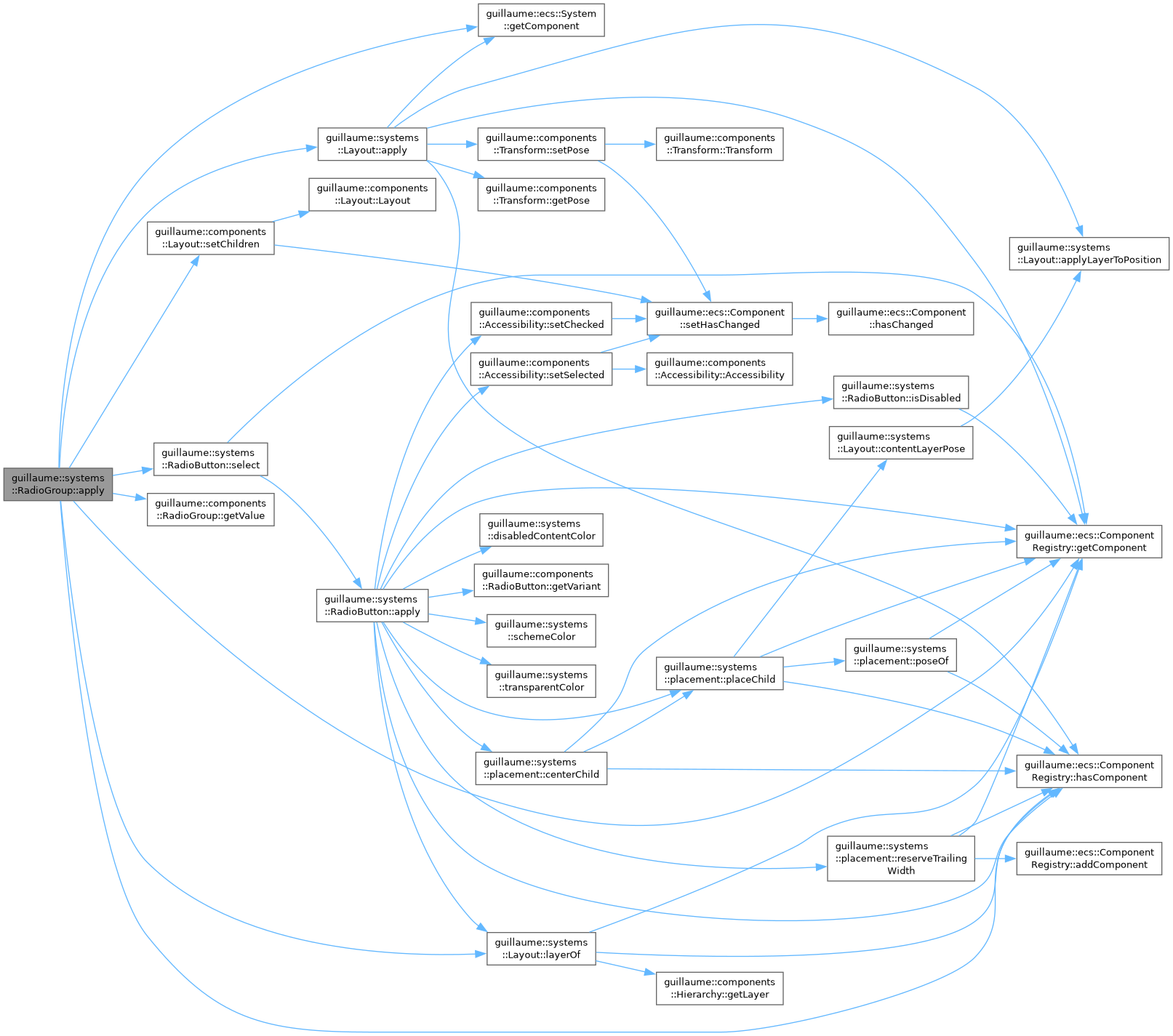
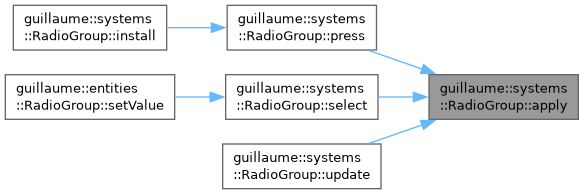
Make the radio buttons agree with the value of the group, then stack them.
The button at the index of the value is selected and every other one deselected; with no value, all are deselected. Only buttons whose selection differs are touched. When the group has a components::Layout, the buttons become its children and systems::Layout::apply places them at once.
The frame calls it through update; select and press call it too. Call it yourself after writing components::RadioGroup::setValue directly.
- Parameters
-
componentRegistry The registry holding the components. entityIdentifier The radio group entity.
Definition at line 108 of file radio_group.cpp.
◆ install()
|
static |
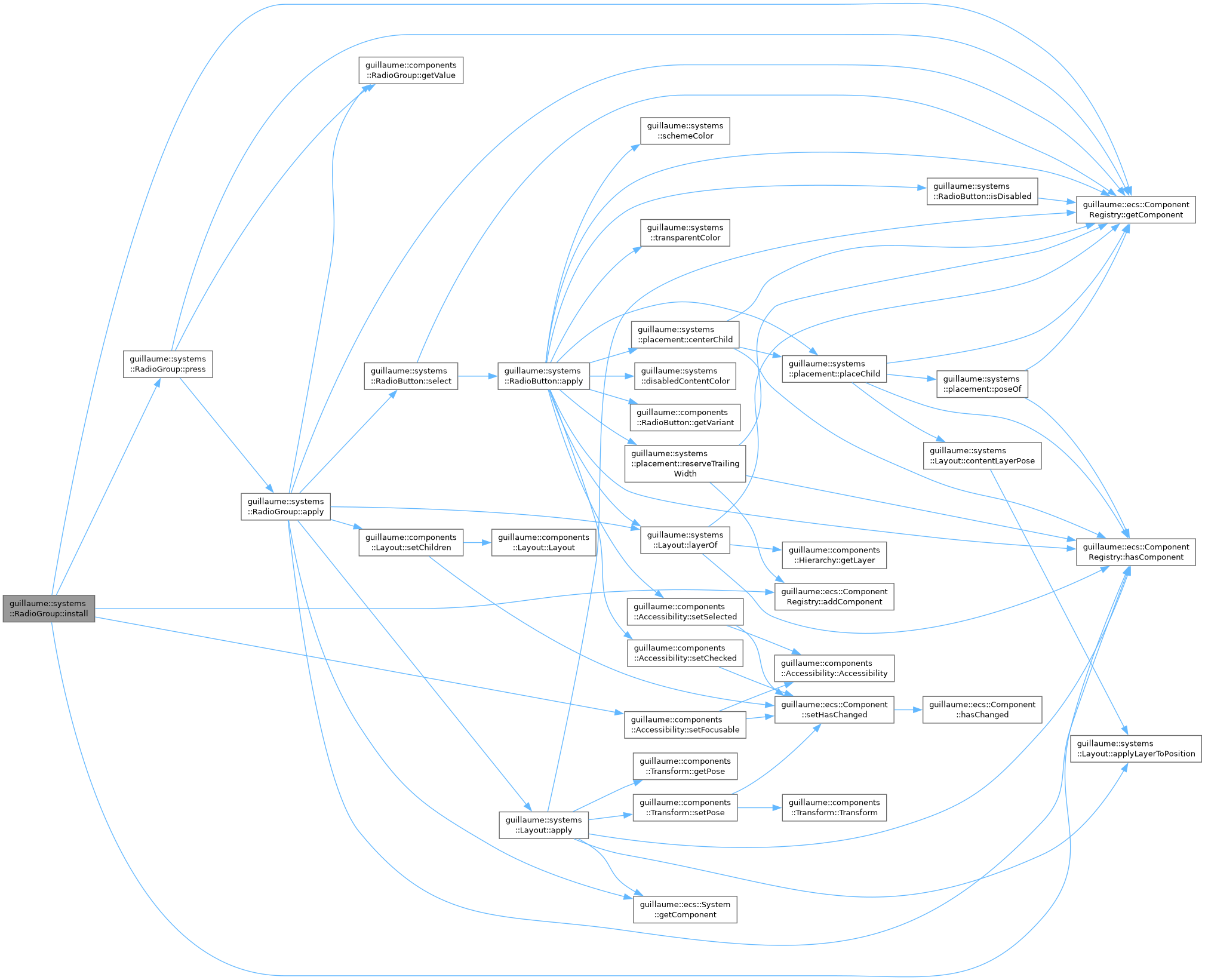
Make an entity behave as a radio group.
Gives the entity a components::Accessibility (added when missing) with the RadioGroup role, not focusable itself, and replaces the press callback of every radio button recorded in the component with one that calls press with the index of that button.
Call it once the radio buttons exist and are recorded in the component, and again whenever they change. A button identifier without a components::RadioButton is skipped. It does not select or place anything: apply does.
- Parameters
-
componentRegistry The registry holding the components. The press callbacks keep its address, so it must outlive the group. entityIdentifier The radio group entity. It must have a components::RadioGroup.
Definition at line 41 of file radio_group.cpp.
◆ press()
|
static |
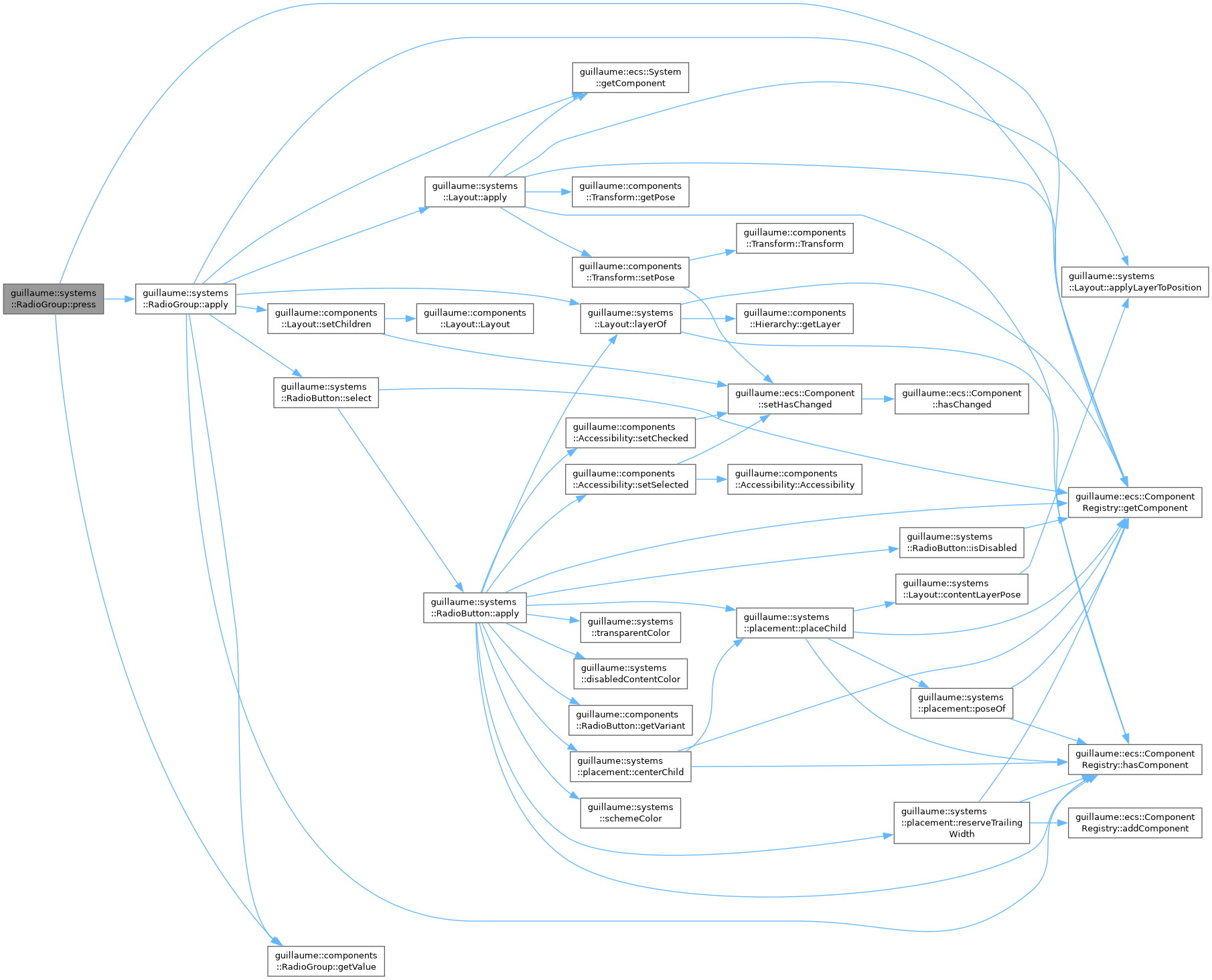
Select an option as a click on its radio button does.
Writes the value of the group, calls apply, then calls the value-change callback of the component with the index, but only when the value really changed: pressing the selected option again calls nothing.
The press callbacks set by install call it; call it directly to simulate a click in a test.
- Parameters
-
componentRegistry The registry holding the components. entityIdentifier The radio group entity. index The zero-based index of the pressed option. The call does nothing, and does not throw, when it is not smaller than the number of radio buttons of the component.
Definition at line 86 of file radio_group.cpp.

◆ select()
|
static |
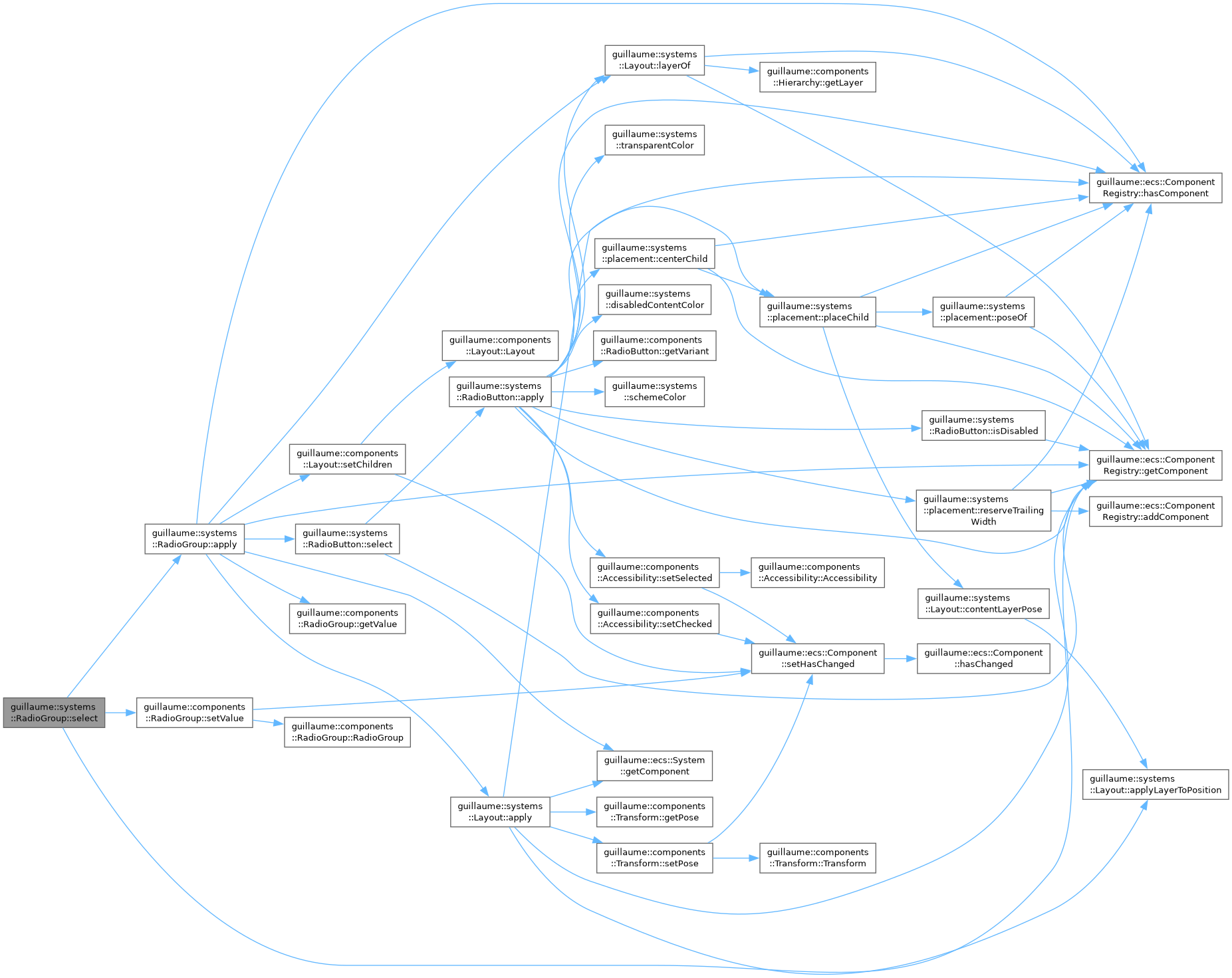
Select an option from code and show it at once.
Writes the value of the group and calls apply. The value-change callback is not called.
- Parameters
-
componentRegistry The registry holding the components. entityIdentifier The radio group entity. index The zero-based index of the option to select.
- Exceptions
-
std::out_of_range If index is not smaller than the number of option labels of the component. Nothing is changed in that case.
Definition at line 72 of file radio_group.cpp.

◆ update()
|
overridevirtual |
Frame entry point: call apply on one radio group.
- Parameters
-
entityIdentifier The radio group entity. An entity without a components::RadioGroup is logged and skipped.
Implements guillaume::ecs::System.
Definition at line 148 of file radio_group.cpp.
The documentation for this class was generated from the following files:
- headers/guillaume/systems/radio_group.hpp
- sources/systems/radio_group.cpp
