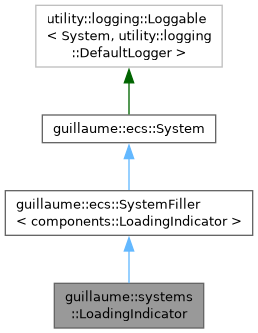
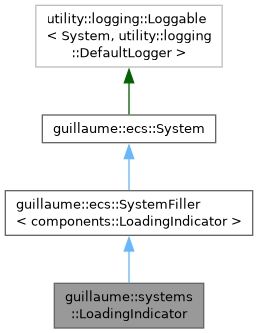
Draws an indeterminate loading indicator: a rotating arc (circular variant) or a bar sliding along a track (linear variant). More...
#include <headers/guillaume/systems/loading_indicator.hpp>
Public Member Functions | |
| LoadingIndicator (void) | |
| Create the system in the Layout phase. | |
| ~LoadingIndicator (void) override=default | |
| Default destructor. | |
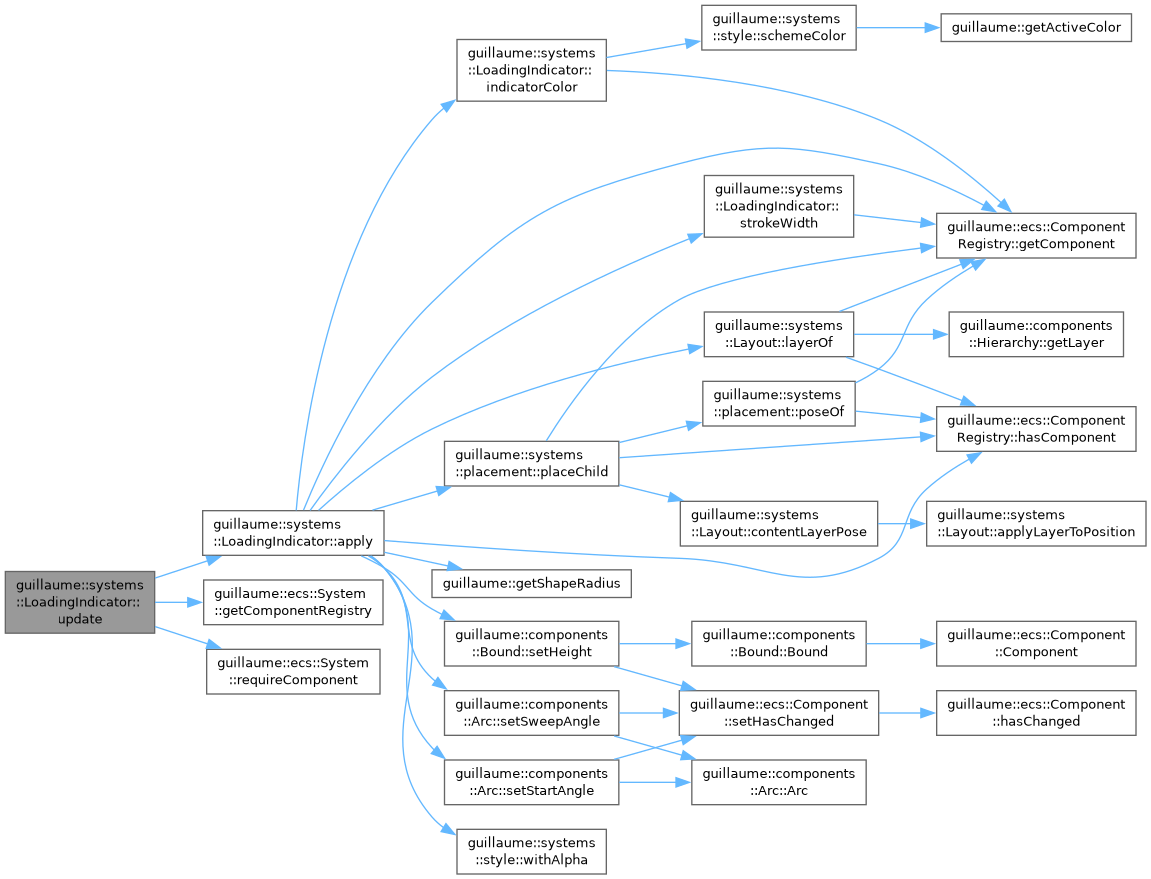
| void | update (const ecs::Entity::Identifier &entityIdentifier) override |
| Run apply() on one loading indicator; called by the frame loop. | |
| Public Member Functions inherited from guillaume::ecs::SystemFiller< components::LoadingIndicator > | |
| SystemFiller (Phase phase) | |
| Create the system and set its signature from ComponentTypes. | |
| virtual | ~SystemFiller (void)=default |
| Virtual destructor. | |
| Public Member Functions inherited from guillaume::ecs::System | |
| System (Phase phase) | |
| Create a system that runs in a given phase, with an empty signature. | |
| virtual | ~System (void)=default |
| Virtual destructor. | |
| Phase | getPhase (void) const noexcept |
| Get the phase of the frame in which the system runs. | |
| Entity::Signature | getSignature (void) const noexcept |
| Get the component types an entity must declare to be visited by this system. | |
| void | routine (ecs::ComponentRegistry &componentRegistry, ecs::EntityRegistry &entityRegistry, const ecs::EntityTreeTraveler &traveler) |
| Run the system once over a scene: prepare(), update() on each matching entity, cleanup(). | |
| void | bindComponentRegistry (ecs::ComponentRegistry &componentRegistry) |
| Bind a component registry so update() can be called directly, without routine(). | |
| void | unbindComponentRegistry (void) |
| Drop the binding made by bindComponentRegistry(). | |
| virtual void | prepare (void) |
| Called once per pass, before the first update(). | |
| virtual void | cleanup (void) |
| Called once per pass, after the last update(). | |
Static Public Member Functions | |
| static void | install (ecs::ComponentRegistry &componentRegistry, const ecs::Entity::Identifier &entityIdentifier) |
| Give a loading indicator its accessibility role and its fade. | |
| static void | installChildren (ecs::ComponentRegistry &componentRegistry, const ecs::Entity::Identifier &entityIdentifier) |
| Wire the looping animation of the animated child and start it. | |
| static void | apply (ecs::ComponentRegistry &componentRegistry, const ecs::Entity::Identifier &entityIdentifier) |
| Size one loading indicator and draw its animated child at the current loop progress and opacity. | |
| static void | start (ecs::ComponentRegistry &componentRegistry, const ecs::Entity::Identifier &entityIdentifier) |
| Start the looping animation and fade the indicator in. | |
| static void | stop (ecs::ComponentRegistry &componentRegistry, const ecs::Entity::Identifier &entityIdentifier) |
| Stop the looping animation. | |
| static bool | isRunning (const ecs::ComponentRegistry &componentRegistry, const ecs::Entity::Identifier &entityIdentifier) |
| Whether the looping animation is running. | |
| static void | startFade (ecs::ComponentRegistry &componentRegistry, const ecs::Entity::Identifier &entityIdentifier) |
| Start fading towards the opacity the running state calls for. | |
| static utility::graphic::Color32Bit | indicatorColor (const ecs::ComponentRegistry &componentRegistry, const ecs::Entity::Identifier &entityIdentifier) |
| Get the color of the arc or bar at full opacity. | |
| static float | strokeWidth (const ecs::ComponentRegistry &componentRegistry, const ecs::Entity::Identifier &entityIdentifier) |
| Get the stroke width of the circular arc, in dp. | |
Additional Inherited Members | |
| Protected Member Functions inherited from guillaume::ecs::System | |
| template<InheritFromComponent... ComponentTypes> | |
| void | setSignature (void) |
| Replace the signature by the one made of the given component types. | |
| ecs::EntityRegistry & | getEntityRegistry (void) |
| Get the entity registry of the scene being processed. | |
| const ecs::EntityRegistry & | getEntityRegistry (void) const |
| Get the entity registry of the scene being processed, read-only. | |
| ecs::ComponentRegistry & | getComponentRegistry (void) |
| Get the component registry of the scene being processed. | |
| const ecs::ComponentRegistry & | getComponentRegistry (void) const |
| Get the component registry of the scene being processed, read-only. | |
| template<InheritFromComponent ComponentType> | |
| bool | hasComponent (const ecs::Entity::Identifier &entityIdentifier) const |
| Tell whether an entity has a component, in the bound registry. | |
| template<InheritFromComponent ComponentType> | |
| ComponentType & | getComponent (const ecs::Entity::Identifier &entityIdentifier) |
| Get a component of an entity from the bound registry, to read or modify it. | |
| template<InheritFromComponent ComponentType> | |
| const ComponentType & | getComponent (const ecs::Entity::Identifier &entityIdentifier) const |
| Get a component of an entity from the bound registry, read-only. | |
| template<InheritFromComponent ComponentType> | |
| bool | requireComponent (const ecs::Entity::Identifier &entityIdentifier) |
| Tell whether an entity has a component, and log a warning naming the entity and the component when it does not. | |
Detailed Description
Draws an indeterminate loading indicator: a rotating arc (circular variant) or a bar sliding along a track (linear variant).
Runs in the Layout phase on every entity that has a components::LoadingIndicator, after systems::Layout.
- Reads: components::LoadingIndicator (variant, size, color override, loop progress, opacity, the identifier of the animated child) and the active theme.
- Writes on the widget: components::Layout (fixed size), components::Borders and a transparent components::Color.
- Writes on the animated child: its Color (faded by the opacity), its Transform and Bound, and either the thickness and angles of its components::Arc or the radius of its components::Borders.
Two components::Animation drive the widget, and both restyle it on every sample, so the indicator moves even between two frames of this system:
- the one on the child loops and writes the loop progress (0 to 1), which becomes the start angle of the arc or the offset of the bar. It is wired by installChildren();
- the one on the widget runs the fade in and out and writes the opacity (0 to 1). It is wired by install().
- See also
- components::LoadingIndicator, entities::LoadingIndicator, systems::Animation, systems::ProgressIndicator
Definition at line 67 of file loading_indicator.hpp.
Constructor & Destructor Documentation
◆ LoadingIndicator()
| guillaume::systems::LoadingIndicator::LoadingIndicator | ( | void | ) |
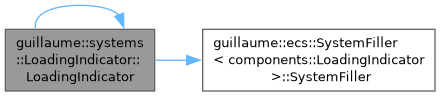
Create the system in the Layout phase.
Definition at line 78 of file loading_indicator.cpp.
Member Function Documentation
◆ apply()
|
static |
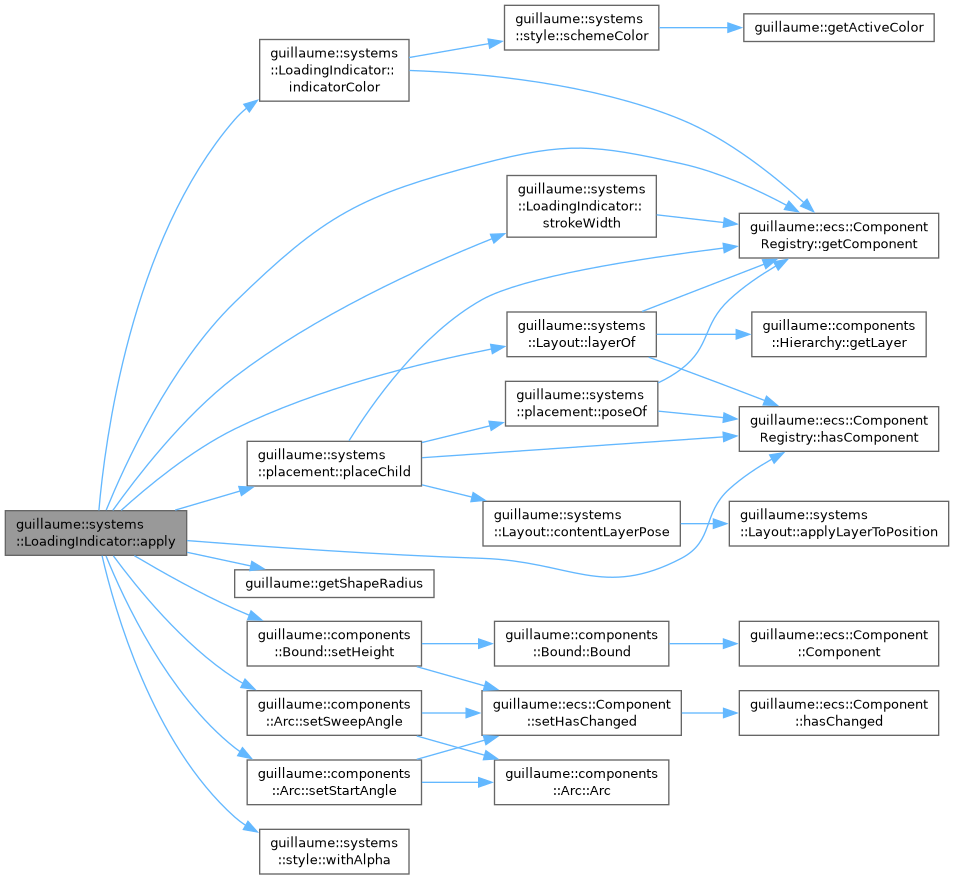
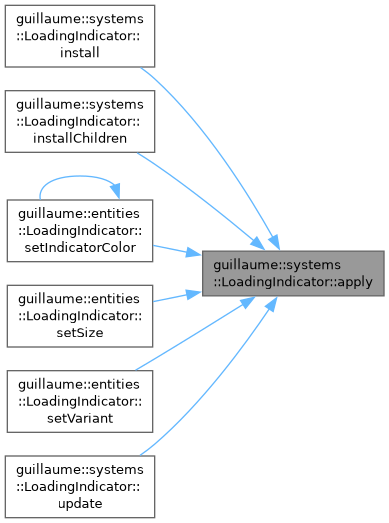
Size one loading indicator and draw its animated child at the current loop progress and opacity.
This is what update() runs each frame, and what both animations call on each sample. Call it directly after changing components::LoadingIndicator to see the result before the next frame.
A circular indicator is a square of the configured size holding an arc of three quarters of a turn whose start angle follows the progress. A linear indicator is a track of components::LoadingIndicator::LinearWidth by LinearHeight in which a shorter bar slides from the left edge to the right edge. The child is left untouched while it has no Bound or no Color.
- Parameters
-
componentRegistry The registry holding the components. entityIdentifier The loading indicator entity.
- Exceptions
-
ecs::EntityComponentNotFoundException When the entity lacks components::LoadingIndicator, Layout, Borders or Color.
Definition at line 134 of file loading_indicator.cpp.
◆ indicatorColor()
|
static |
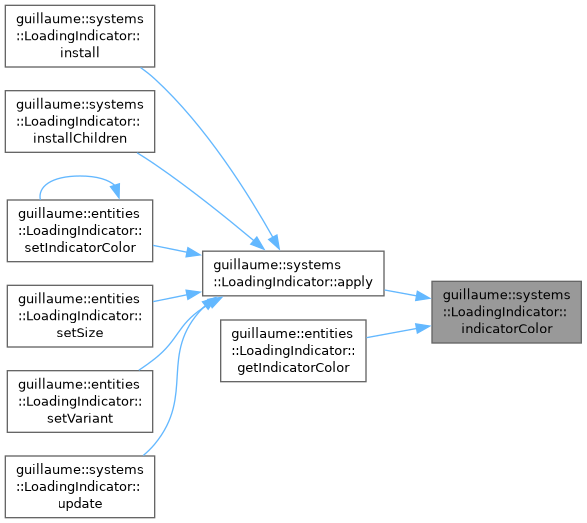
Get the color of the arc or bar at full opacity.
- Parameters
-
componentRegistry The registry holding the components. entityIdentifier The loading indicator entity.
- Returns
- The color override of components::LoadingIndicator when one is set, otherwise the primary color of the active theme.
Definition at line 270 of file loading_indicator.cpp.

◆ install()
|
static |
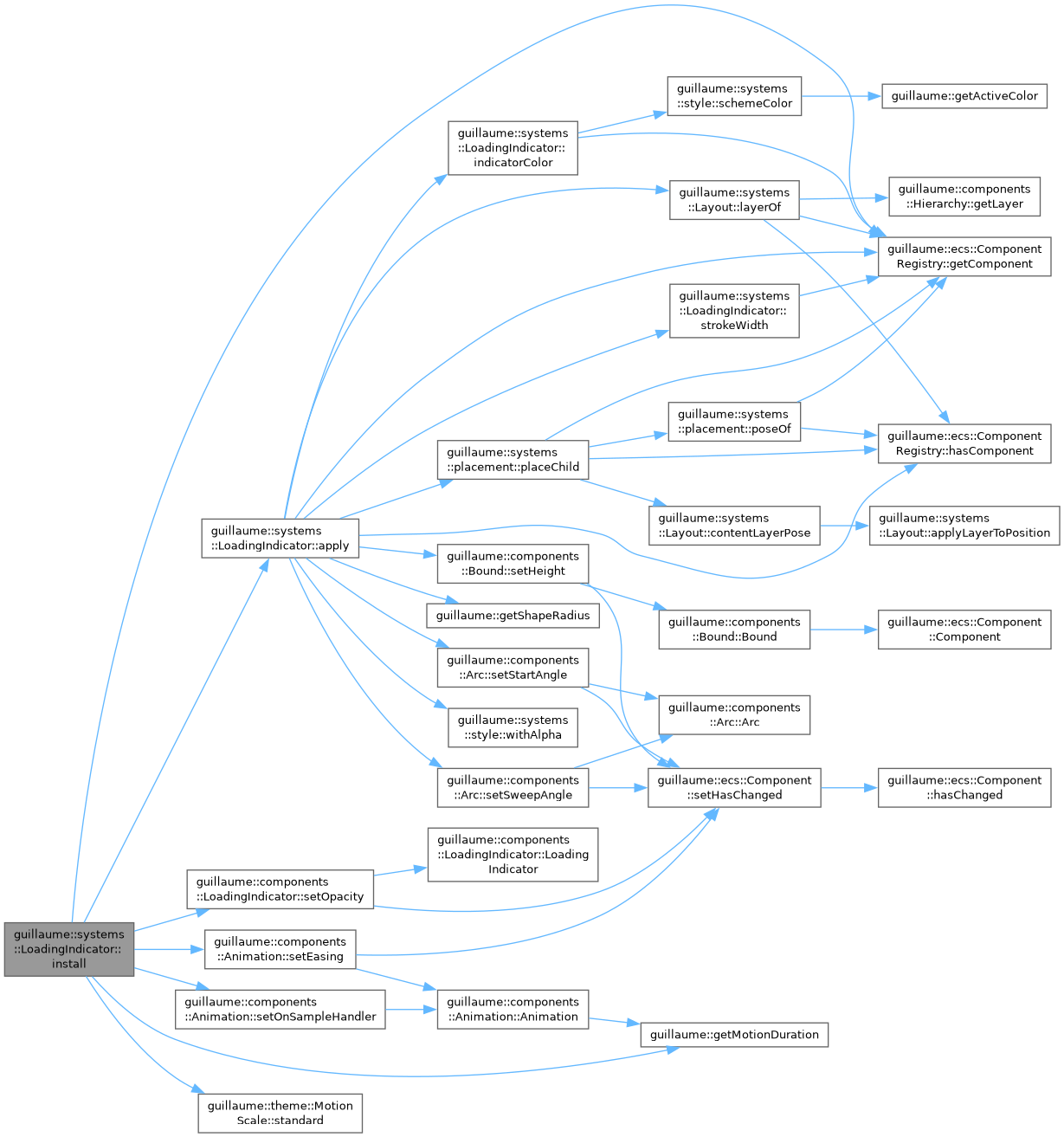
Give a loading indicator its accessibility role and its fade.
Sets the role of its components::Accessibility to ProgressBar, and sets up the widget's own components::Animation so that each sample moves the opacity from the value recorded by startFade() to its target and calls apply(). Call it once, after the entity has its components::LoadingIndicator, Animation, Accessibility, Layout, Borders, Color, Transform and Bound.
- Parameters
-
componentRegistry The registry holding the components. It is captured by the sample handler and must outlive the entity. entityIdentifier The loading indicator entity.
- Exceptions
-
ecs::EntityComponentNotFoundException When the entity has no components::Accessibility or components::Animation.
Definition at line 83 of file loading_indicator.cpp.
◆ installChildren()
|
static |
Wire the looping animation of the animated child and start it.
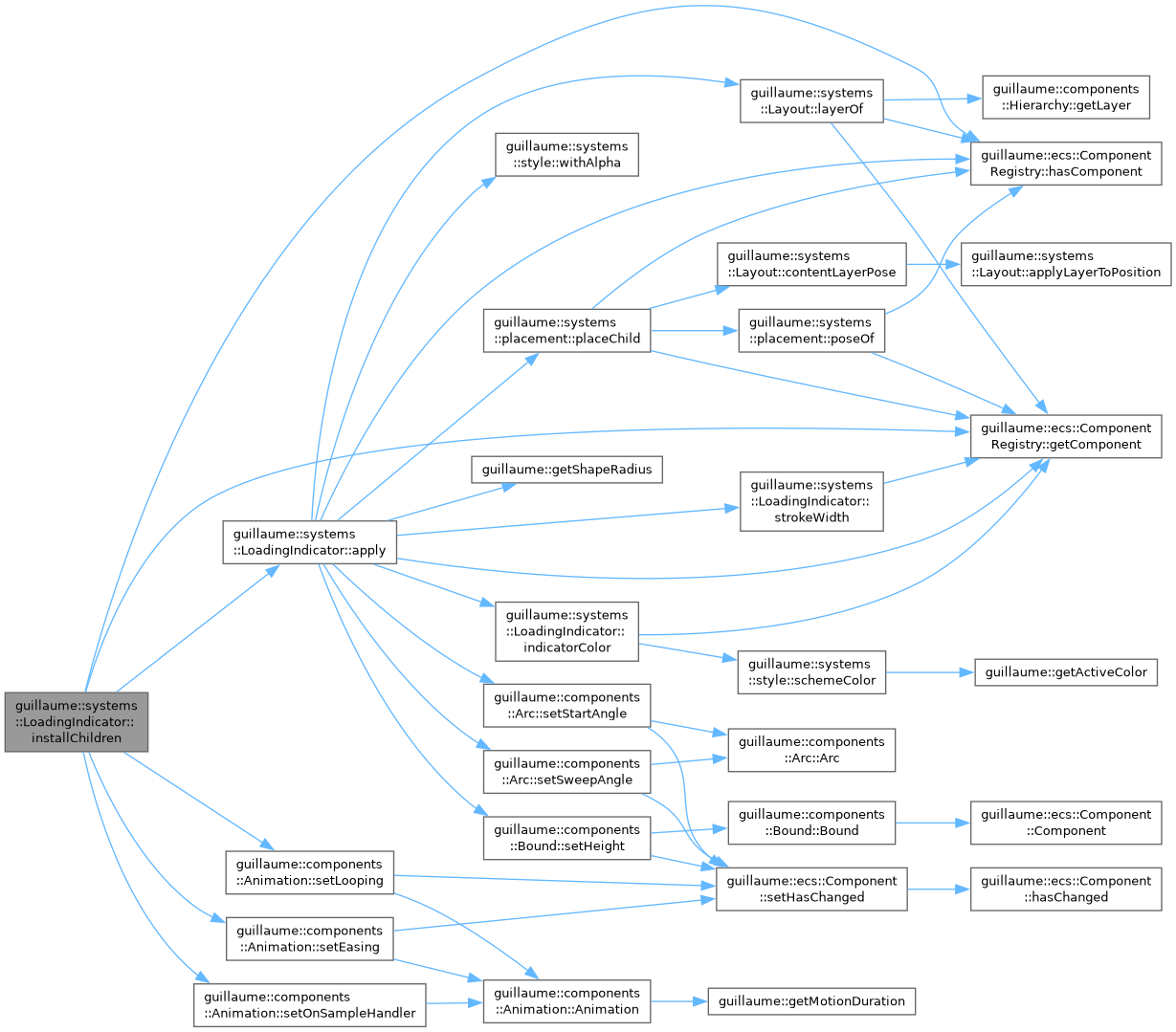
Makes the components::Animation of the child recorded in components::LoadingIndicator loop, write the loop progress on each sample and call apply(), then plays it: the indicator runs as soon as this returns. Call it each time a child has been recorded in the component, for instance after the variant changed and the child was rebuilt. Does nothing when the child has no components::Animation.
- Parameters
-
componentRegistry The registry holding the components. It is captured by the sample handler and must outlive the entity. entityIdentifier The loading indicator entity.
Definition at line 107 of file loading_indicator.cpp.
◆ isRunning()
|
static |
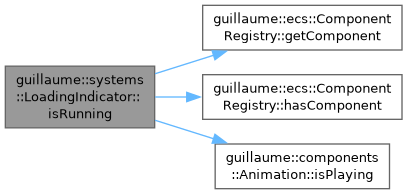
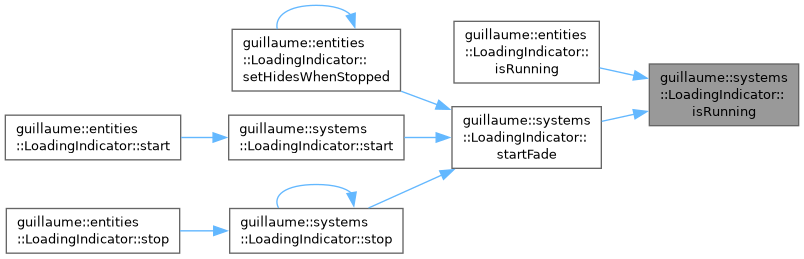
Whether the looping animation is running.
- Parameters
-
componentRegistry The registry holding the components. entityIdentifier The loading indicator entity.
- Returns
- True when the animated child has a components::Animation that is playing; false when there is no such child.
Definition at line 235 of file loading_indicator.cpp.
◆ start()
|
static |
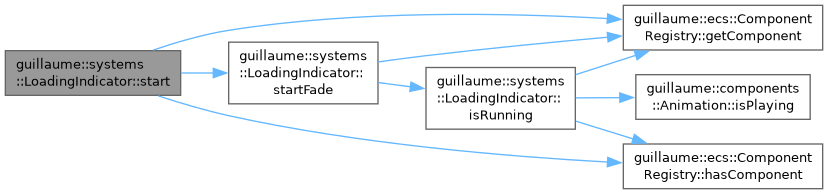
Start the looping animation and fade the indicator in.
- Parameters
-
componentRegistry The registry holding the components. entityIdentifier The loading indicator entity.
Definition at line 207 of file loading_indicator.cpp.

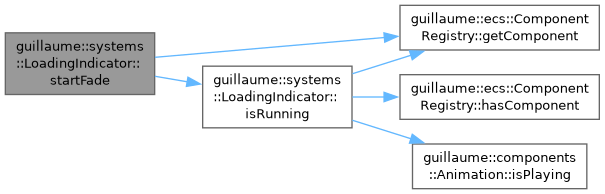
◆ startFade()
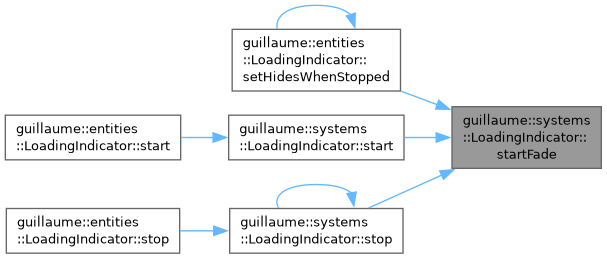
|
static |
Start fading towards the opacity the running state calls for.
The target opacity is 1 while the indicator is running, or when it does not hide when stopped, and 0 otherwise. The fade starts from the current opacity and is played by the widget's own components::Animation. Does nothing when the indicator is already at the target. start() and stop() call it; call it yourself after changing the hide-when-stopped setting.
- Parameters
-
componentRegistry The registry holding the components. entityIdentifier The loading indicator entity.
Definition at line 249 of file loading_indicator.cpp.
◆ stop()
|
static |
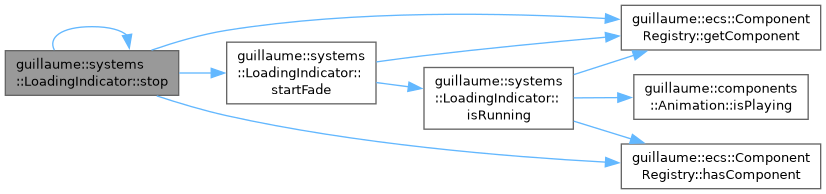
Stop the looping animation.
The indicator also fades out when its component is set to hide when stopped; otherwise it stays visible, frozen where it stopped.
- Parameters
-
componentRegistry The registry holding the components. entityIdentifier The loading indicator entity.
Definition at line 221 of file loading_indicator.cpp.

◆ strokeWidth()
|
static |
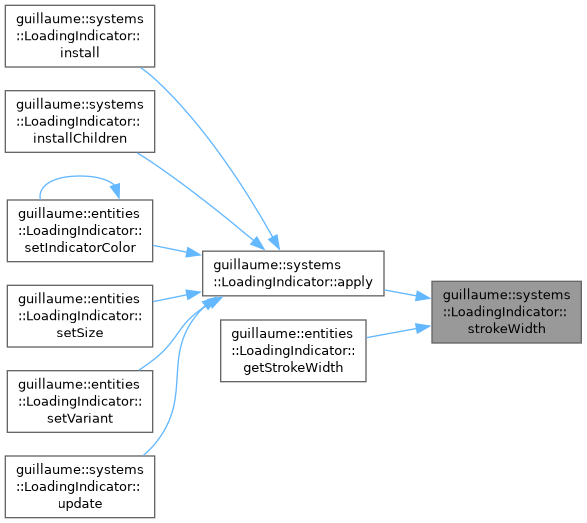
Get the stroke width of the circular arc, in dp.
- Parameters
-
componentRegistry The registry holding the components. entityIdentifier The loading indicator entity.
- Returns
- The configured size multiplied by components::LoadingIndicator::StrokeRatio (4 dp for a 48 dp indicator).
Definition at line 280 of file loading_indicator.cpp.

◆ update()
|
overridevirtual |
Run apply() on one loading indicator; called by the frame loop.
Logs a warning and does nothing when the entity has no components::LoadingIndicator.
- Parameters
-
entityIdentifier The loading indicator entity.
Implements guillaume::ecs::System.
Definition at line 290 of file loading_indicator.cpp.
The documentation for this class was generated from the following files:
- headers/guillaume/systems/loading_indicator.hpp
- sources/systems/loading_indicator.cpp
